
HVAC employers in the United States need to fill roughly 40,100 jobs every year through 2034, and there aren't enough new technicians entering the trade to keep pace. That figure comes straight from the U.S. Bureau of Labor Statistics, and it's the single most important number for anyone hiring HVAC techs right now: the demand is structural, not a temporary blip. This report breaks down the workforce behind that number — how many techs there are, where they work, what they earn, who's about to retire, and what the smartest employers are doing to compete.
All wage and employment figures here come from the BLS Occupational Employment and Wage Statistics program (SOC 49-9021) and the BLS Employment Projections program, using the most recent data available as of May 2025. Where we cite industry estimates, we name the source so you can judge it yourself.
About 425,200 people worked as heating, air conditioning, and refrigeration mechanics and installers in 2024, the base year for the current BLS projections. Roughly 70% of them work for plumbing, heating, and air-conditioning contractors, with another 5% self-employed and the rest spread across wholesale trade, schools, and retail. This is a contractor's trade, which means hiring pressure lands hardest on the small and mid-size shops that make up most of the industry.
The work itself is concentrated. The top 10 states hold about 53% of all HVAC jobs in the country. Florida leads with 39,160 technicians, followed by California (35,130) and Texas (34,730). New York (24,430), Pennsylvania (15,880), North Carolina (15,230), Virginia (14,690), Ohio (14,150), Michigan (12,590), and Georgia (12,290) round out the top 10.
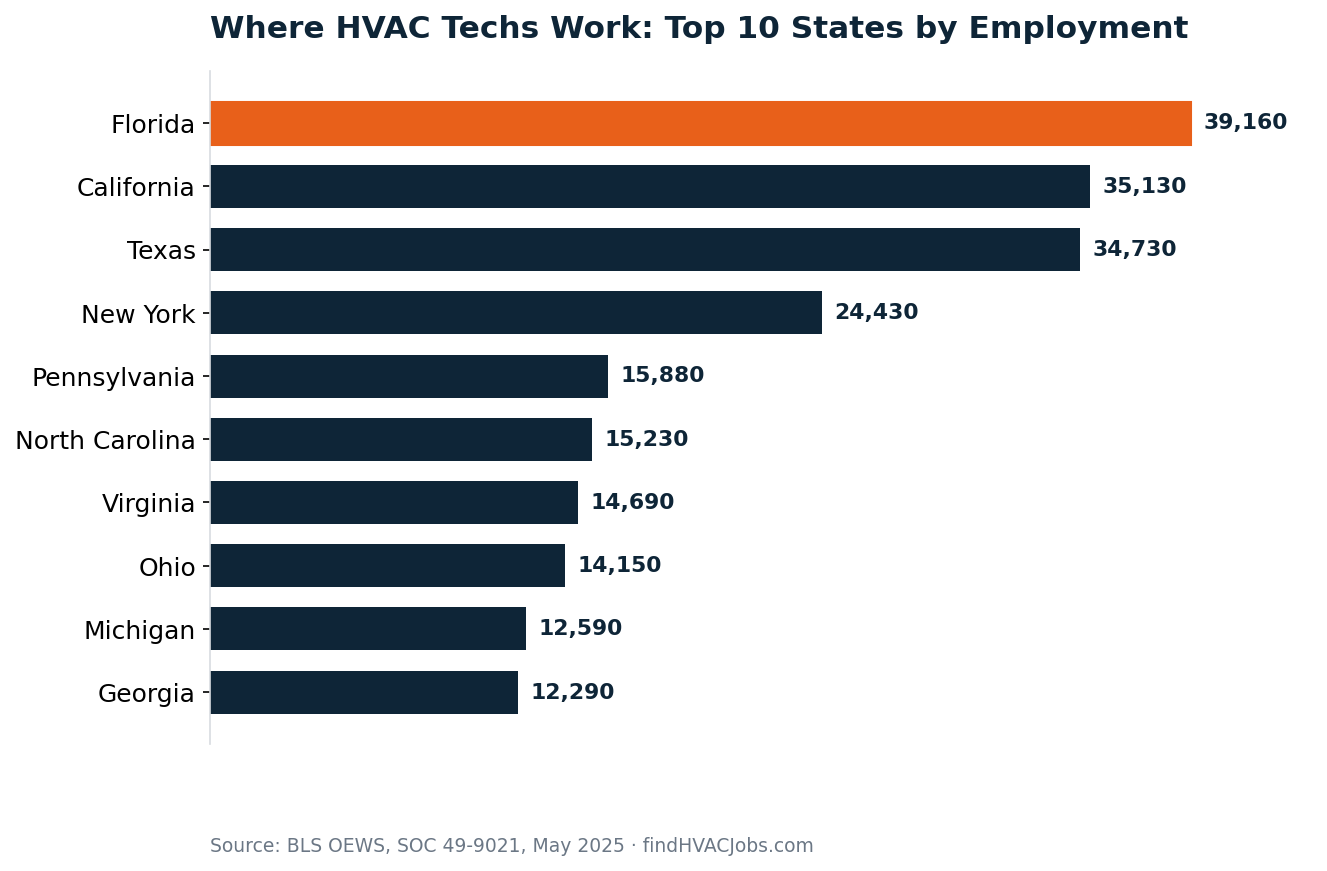
There's a clear migration story in those numbers. Nine warm-weather, fast-growing states — Florida, Texas, California, Arizona, Georgia, North Carolina, Nevada, South Carolina, and Tennessee — together account for about 41% of the national HVAC workforce. As people and construction move south, cooling demand and the jobs that come with it follow.
The honest answer is that nobody knows the exact number, and the published estimates vary widely. What's solid is the BLS math: about 40,100 openings per year over the 2024–2034 decade. Most of those openings aren't from growth — they come from replacement needs, meaning workers who retire or move to other occupations and have to be backfilled.
On top of replacement demand, employment in the trade is projected to grow 8% from 2024 to 2034, which BLS calls "much faster than average" (the all-occupations average is 3%). That's a net gain of about 34,500 jobs, pushing the workforce to roughly 459,700 by 2034.
Industry groups put a harder number on the gap. According to a 2025 industry report from the Sheet Metal and Air Conditioning Contractors' National Association (SMACNA), the HVAC field has around 110,000 unfilled technician positions — roughly 38% of what the industry says it needs to meet current demand. Industry coverage also estimates that about 25,000 technicians leave the workforce each year. Treat these as industry estimates rather than government data, but the direction is consistent across every source: demand is outrunning supply.
The biggest driver of all those openings is age. The average HVAC technician is now around 55 years old, according to figures cited from the Air Conditioning Contractors of America (ACCA). A large share of the most experienced techs in the country are within a decade of retirement, and they're leaving faster than new workers are coming in.
That matters for two reasons. First, it's a volume problem — every retiree is an opening that has to be filled. Second, it's a knowledge problem. When a 30-year veteran retires, the diagnostic instinct and jobsite judgment they carry walk out the door with them. For employers, that raises the value of retaining mid-career techs and building real training pipelines instead of assuming the labor market will sort itself out.
When demand outruns supply, wages climb — and HVAC pay is climbing fast. The mean annual wage reached $64,790 in May 2025, up from $60,100 a year earlier. Over the past four years, average HVAC pay has risen about 18%, a steeper trajectory than most skilled trades.
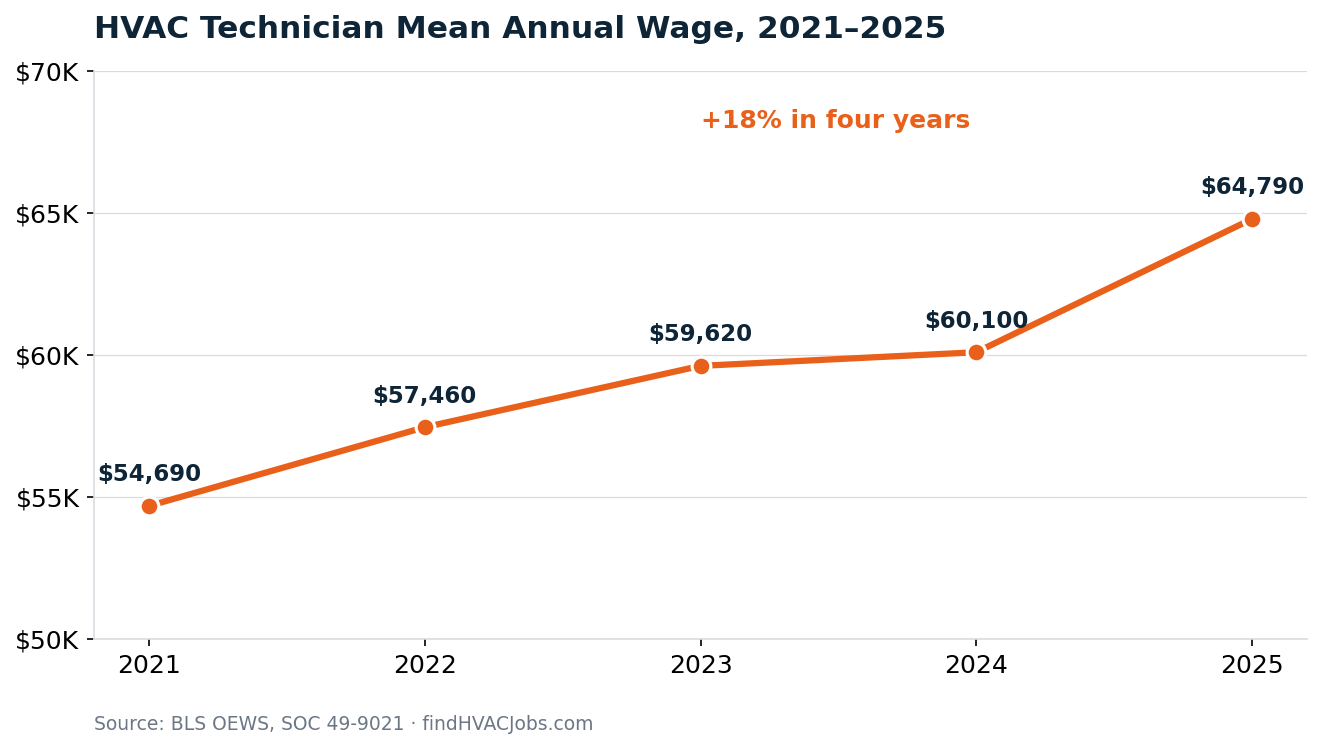
The range is wide. Entry-level helpers generally start in the high-$30,000s, while the most experienced commercial techs, specialists, and leads clear $90,000 and up. Pay varies a lot by geography too, which brings us to one of the more surprising findings in this year's data. For a full breakdown by experience level and state, see our HVAC salary guide.
The states that pay the most and the states that employ the most barely overlap. The highest mean wages are in the District of Columbia ($84,920), Alaska ($80,150), Washington ($78,860), Massachusetts ($77,760), and New Jersey ($77,580). But the states with the most jobs are Florida, California, and Texas. Only California and New York show up in both top-10 lists.
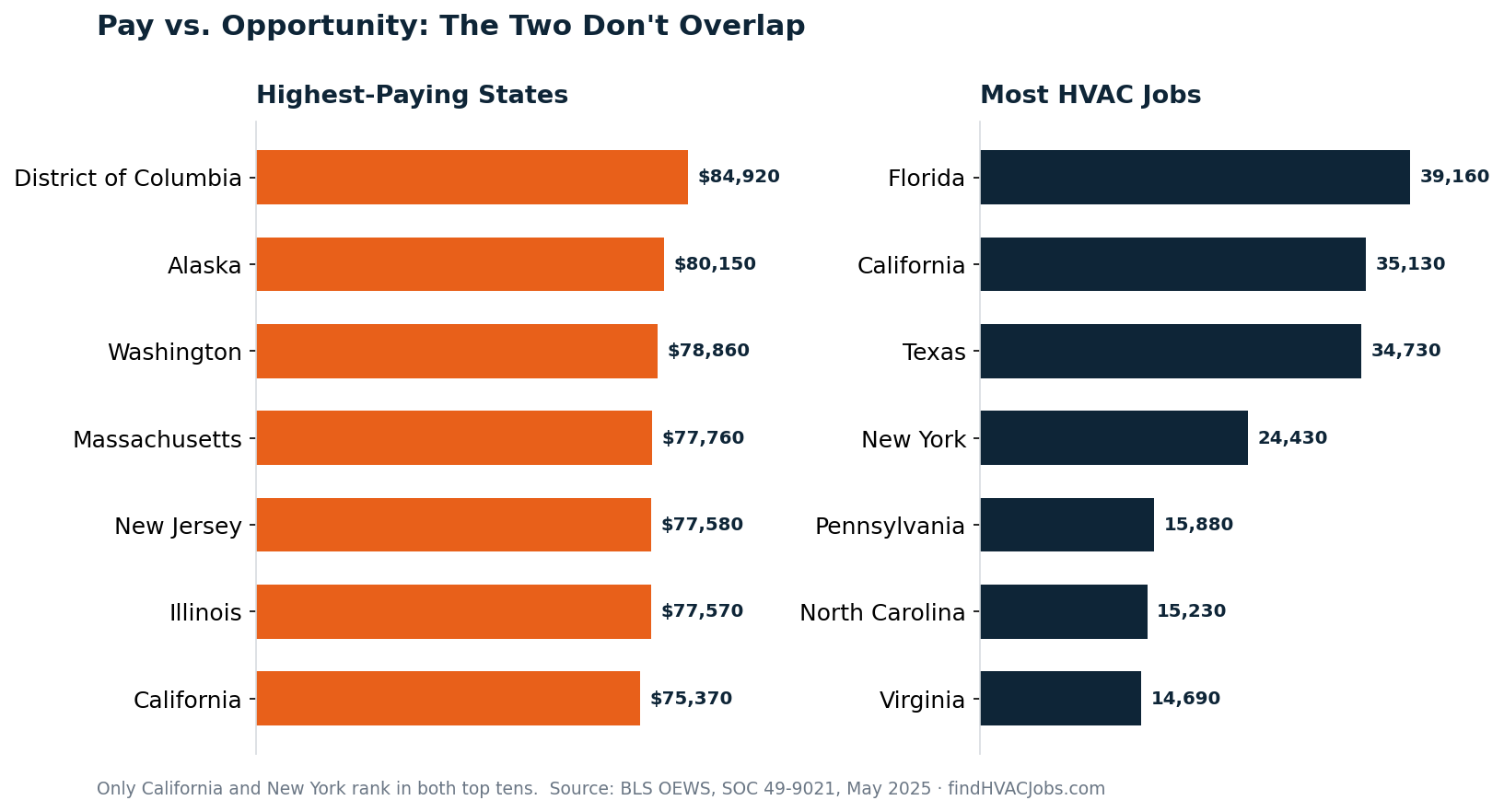
For job seekers, that's a real decision: chase the highest sticker wage in a high-cost northern market, or take a slightly lower number in a high-volume Sunbelt market where the cost of living stretches it further. For employers, it's a recruiting reality — if you're hiring in a high-employment, mid-wage state, your competition isn't just other HVAC shops, it's every contractor within driving distance.
At the metro level, the New York area is in a league of its own with about 21,820 technicians. After that the biggest markets are Dallas (10,910), Los Angeles (10,720), Miami (9,140), Washington, D.C. (8,730), Philadelphia (8,610), Phoenix (8,070), Houston (7,680), Chicago (7,210), and Atlanta (7,060). These ten metros are where hiring competition is fiercest and where a well-placed job posting reaches the deepest candidate pool.
If demand is this strong and pay is rising this fast, why isn't the gap closing? Part of the answer is that the training pipeline is thin relative to need. The formal school system produces a limited number of completers each year — across the 50 states, the strongest programs number only in the low hundreds — against 40,100 annual openings. Most new techs still come through apprenticeships, on-the-job entry, and migration from adjacent trades rather than from a degree program.
Entry also isn't frictionless. Most states gate the trade behind licensing: more than half of U.S. jurisdictions require a statewide HVAC or HVACR license, on top of the federal EPA Section 608 certification nearly every tech needs to handle refrigerants. That's good for wages and professionalism, but it adds time and cost to becoming job-ready. Our HVAC license guide breaks down the requirements state by state.
Contractors who are winning the hiring race aren't waiting for the labor market to fix itself. The most common moves: raising pay to stay competitive with the rising market, signing bonuses for experienced techs, and tool and vehicle allowances that lower a tech's out-of-pocket cost of doing the job. Beyond compensation, the employers with the lowest turnover invest in clear advancement paths, continuing-education support, and apprenticeship partnerships with local schools and unions that build their own pipeline instead of fighting over the same shrinking pool.
The single cheapest lever is often where you post the job. Casting a wide net on a general board buries an HVAC role under hundreds of unrelated applicants. A niche board reaches pre-qualified HVAC professionals directly. If you're hiring, you can post a job on findHVACJobs.com and put your opening in front of an audience that's actually in the trade.
The pressure contractors feel today isn't going away. BLS projects 8% growth and about 40,100 openings a year through 2034, and the aging workforce guarantees that replacement demand stays high for years. New construction, the shift to energy-efficient systems, the move to next-generation refrigerants, and rising cooling demand in a warming Sunbelt all point the same direction: more systems to install and maintain, and a workforce that has to grow to match.
For job seekers, that's about as much job security as any career offers, with wages rising to match. For employers, it's a call to treat hiring and retention as a permanent strategic priority, not a seasonal scramble. The companies that build their talent pipeline now — through competitive pay, real training, and smart recruiting — will be the ones still fully staffed when the next heat wave hits.
Ready to find your next technician? Post your HVAC job on findHVACJobs.com and reach qualified candidates faster, or browse current HVAC openings to see what's hiring in your market right now.
Data sources: U.S. Bureau of Labor Statistics, Occupational Employment and Wage Statistics (SOC 49-9021, May 2025) and Employment Projections program (2024–2034). Workforce-shortage and average-age figures are industry estimates from SMACNA and ACCA as noted. Figures are provided for informational purposes and may be updated as new data is released.
