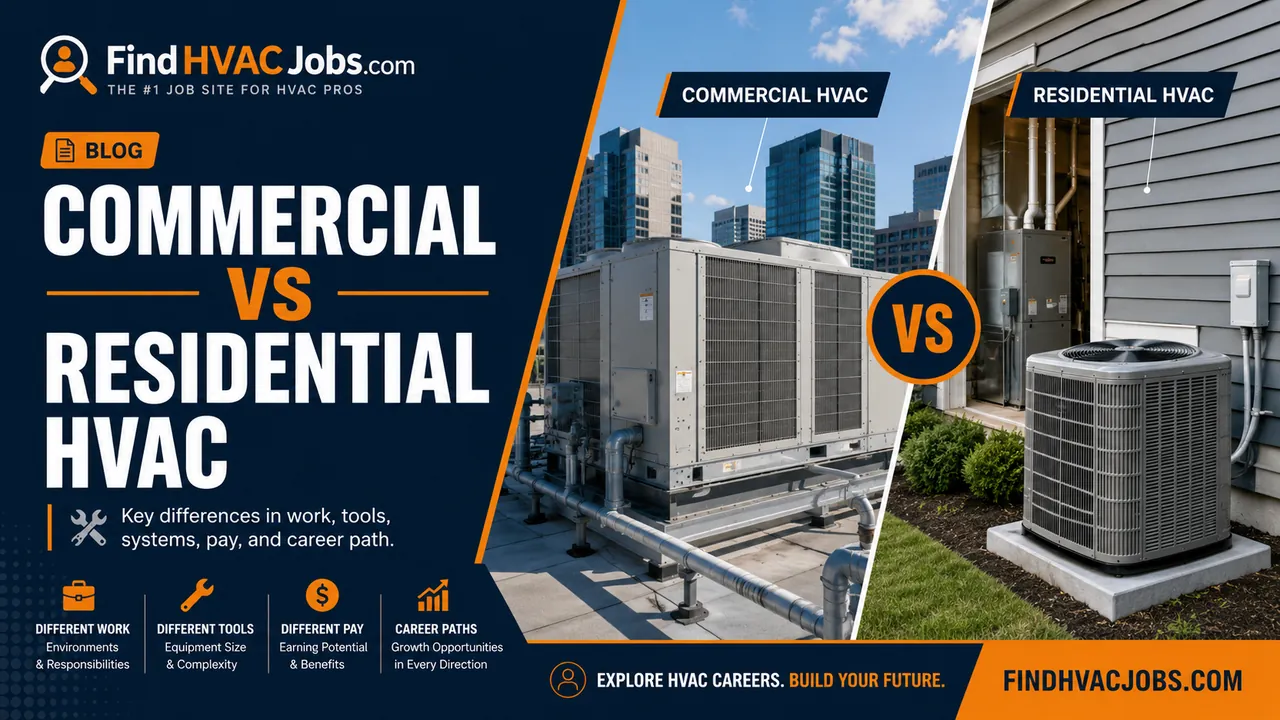
If you're deciding between commercial vs residential HVAC, start with the money, because that's the question everyone actually has. Commercial techs earn roughly 20 to 30 percent more than residential techs on average. But pay isn't the whole story, and for a lot of people it isn't even the deciding factor. The two paths are different jobs that happen to share a trade. Different equipment, different schedule, different kind of day, different ceiling. Pick wrong for your personality and the raise won't matter.
Here's the part nobody tells you at the start: switching lanes later is normal. Plenty of techs cut their teeth on residential because it's the easier door to walk through, then move to commercial once they've got a few seasons under their belt. So this isn't a one-time, locked-in decision. It's just the smart way to point your first few years.
The combined national average for HVAC mechanics and installers is $64,780 per year, according to the May 2025 BLS OEWS data (SOC 49-9021). That figure averages residential and commercial work together, which is why it sits in the middle and doesn't tell you much about either path on its own.
When you split them apart, here's the honest range. BLS doesn't publish a commercial-versus-residential breakout, so these come from industry pay data, not the government table:
The commercial premium is real and it's consistent across pay surveys. The reason is straightforward. Commercial systems are bigger and more complex, downtime costs the building owner real money, and the clients have deeper pockets than a homeowner replacing one furnace. A chiller dropping offline at a hospital is a different financial emergency than a no-cool call at a ranch house.
But residential has a wildcard: commission. A strong residential service tech who's good at the sales side can out-earn a salaried commercial tech in a hot summer, between equipment spiffs and maintenance-plan signups. The pay is lumpier and more tied to your closing skills, but the ceiling on a great residential salesperson is higher than the flat hourly number suggests. For the full picture by experience level and certification, see our HVAC salary guide.
Location moves the needle harder than the commercial/residential split does. A commercial tech in Chicago (metro average around $79,340) is in a different universe than a residential tech in a milder, lower-cost market. Union density and climate do most of the heavy lifting. Massachusetts and Illinois pay well partly because of strong union presence and harsh winters; Florida and much of Texas pay less per hour even with year-round AC demand. You can browse current openings and real posted wages on the HVAC technician jobs board to see what your market actually pays right now.
This is where the two paths really separate. The systems you touch every day shape the skills you build, and the skills you build set your ceiling.
Residential is splits, furnaces, heat pumps, and mini-splits. Two- to five-ton systems sized for a single family. You'll spend your days on gauges, a combustion analyzer, and a lot of diagnostics on equipment a homeowner ran into the ground because they never changed the filter. The work is varied because every house is a little different and most of them were not built with the HVAC tech in mind.
Commercial is rooftop package units (RTUs), chillers (air-cooled and water-cooled), cooling towers, VAV boxes, and increasingly VRF systems. The big differentiator is building automation. A commercial tech reads a building automation system, a Tridium Niagara front end, a Johnson Controls Metasys panel, or a Honeywell controller, and troubleshoots from a laptop as often as from a gauge set. That controls knowledge is the single most valuable skill in the commercial side, and it's the reason controls techs sit at the top of the pay band.
Refrigeration is its own world that mostly lives on the commercial side: walk-in coolers, supermarket rack systems, and the certs that go with handling those bigger charges. It pays a premium and the demand is steady because a grocery store can't let a rack go down. If that work interests you, the refrigeration jobs board is worth a look, and our EPA 608 certification guide covers the credential you'll need before you touch any of it.
The schedule difference is the one I'd tell a younger version of myself to weigh hardest, because it shapes your whole life outside work.
Commercial leans toward predictable weekdays. Most commercial work runs on preventive-maintenance contracts: scheduled filter changes, belt swaps, coil cleanings, and equipment checks during normal business hours. You'll still catch emergency calls when a chiller alarms or a rooftop unit dies in a heat wave, but the baseline is a steadier Monday-through-Friday rhythm. More commercial shops are W-2 with real benefits, and union shops add structure on top of that.
Residential lives and dies by the weather. When it hits 100 degrees and every AC in town is struggling, the phone does not stop, and a lot of residential techs run heavy on-call through summer evenings and weekends. That's also when the overtime and the commission show up, so it cuts both ways. The off-season can go quiet, which is the flip side people forget about.
On the physical side, residential is the harder environment in my experience. You're in attics that hit 130 degrees in August, in crawlspaces, and folded into a closet that someone built a furnace into as an afterthought. Commercial has its own grind. You're on a roof in July walking a hot membrane between twenty RTUs, hauling gear up a ladder, and the equipment is heavier. Neither one is easy on the knees. They're just hard in different ways.
The clearest way to feel the difference is to walk through a typical day on each side.
A residential tech might run six stops: a maintenance tune-up first thing, a no-cool diagnostic where the capacitor's bulging, a couple of repairs, a quick filter-and-fix, and a sit-down with a homeowner to walk through a system replacement. That last one is a sales call as much as a service call, and how you handle it shows up in your paycheck. Lots of driving, lots of faces, lots of context-switching. The annoyance that bites you is the callback: the drain line you didn't fully clear coming back to haunt you three days later.
A commercial tech's day skews toward fewer sites and deeper work. Maybe a morning dispatch or safety briefing, then PM rounds across a building's rooftop units, lunch, an afternoon chiller alarm that turns into a real troubleshooting session on the BAS, and paperwork logging it all before you head out. You talk to facility managers and building engineers, not homeowners, so the people side is more technical and less emotional. The work is slower and more methodical, which some techs love and others find boring. For the full hour-by-hour version, our day in the life of an HVAC technician follows a residential tech and a commercial tech through the same day.
Both paths have a real ceiling. They just point in different directions.
Commercial has the cleaner, more linear climb: service tech to controls tech to building engineer to chief engineer, or sideways into estimating and project management. Big facilities, hospitals, universities, and data centers need building engineers and pay them well for keeping critical systems alive. If you want a clear ladder with each rung paying more, commercial is the obvious bet, and the controls specialization is the fastest way up it.
Residential has a messier ceiling that's actually higher at the top, because the path runs through ownership. You can climb to lead installer or service manager, slide into comfort-advisor sales where the best earners clear six figures on commission, or do what a huge share of shop owners did and start your own company. The trade is full of $2-3 million family shops that began with one good residential tech and a van. If you've got any entrepreneurial itch, residential is the better training ground for running your own business.
On the employer side, commercial work comes from mechanical contractors, large service firms like CoolSys and EMCOR, the service divisions of Trane and Carrier, and in-house facilities teams. Residential work comes from local shops and franchises. You can scan both kinds of employers on the main HVAC jobs board or filter straight to technician roles.
Some credentials are table stakes for both, and a few separate the higher earners.
For the bigger menu of credentials and what each one adds to your pay, see our HVAC certifications guide, and check your state's rules in the HVAC license requirements by state breakdown before you commit to a path.
Skip the personality-quiz fluff. Here's the practical read.
Go residential if you like variety, you're good with people, you don't mind a fast pace and a lot of driving, and you want sales-and-commission upside or eventually your own shop. It's also the easier path to enter as a newcomer, which is why most people start here. If you're brand new, our how to become an HVAC technician guide and the HVAC apprenticeship guide lay out the on-ramp.
Go commercial if you want the higher baseline pay, a steadier weekday schedule, deep technical work on complex equipment, and a stable W-2 with benefits. The controls path in particular rewards techs who'd rather master a system than master a sales pitch.
Your local market matters too. Dense, commercial-heavy metros like Chicago and New York have more commercial and union work to walk into, while fast-growing residential markets like Phoenix, Atlanta, Houston, and the Florida metros of Miami and Tampa churn out residential replacement work year-round. Look at what's actually posted near you before you decide. And remember the escape hatch: starting on one side does not trap you there. A residential tech who picks up controls knowledge is exactly the kind of hire commercial shops fight over.
Ready to compare real openings? Browse commercial HVAC jobs and residential HVAC jobs side by side, with the posted wages right there so you can see what each path pays in your area.
Is commercial HVAC worth it? For most techs who want higher steady pay and a predictable weekday schedule, yes. Commercial pays roughly 20 to 30 percent more than residential on average, and the controls specialty pushes well into the $90,000s. The tradeoff is less variety and a slower, more methodical day. If you'd rather sell, talk to customers, and chase commission, residential may suit you better.
Does commercial HVAC pay more than residential? Yes, on average. The combined national mean for HVAC mechanics is $64,780 (May 2025 BLS OEWS), but split apart, commercial techs typically run $65,000 to $85,000 while residential service techs run $50,000 to $70,000. Strong residential sales techs can close that gap or beat it through commission, so the averages don't tell the whole story.
Should I switch from residential to commercial HVAC? It's a common and welcome move in the trade. Residential teaches you fundamentals and customer skills fast, and commercial shops actively want techs who already know diagnostics and can pick up building automation. The biggest jump in pay usually comes from learning controls (Tridium Niagara, Metasys, and similar systems), so start there if a switch is the goal.
Is commercial or residential HVAC harder? They're hard in different ways. Residential punishes your body more (130-degree attics, crawlspaces, tight closets) and demands faster context-switching across many calls a day. Commercial demands deeper technical knowledge of complex systems and controls, with heavier equipment but a steadier pace. Neither is "easy."
Which pays more over a full career, commercial or residential? Commercial has the higher and more predictable salaried ceiling through the building-engineer and controls path. Residential has the higher ceiling if you go the ownership route, since the trade is full of profitable shops that started with one residential tech and a van. Your earning peak depends more on whether you climb a ladder or build a business than on which side you start.
Salary figures: combined national mean from BLS OEWS, May 2025 (SOC 49-9021, Heating, Air Conditioning, and Refrigeration Mechanics and Installers). Commercial and residential ranges are industry-observed and not separately published by BLS. Figures reflect national averages and may differ from local market conditions.
Still mapping out your entry into the trade? Start with the bigger picture in how to become an HVAC technician.
