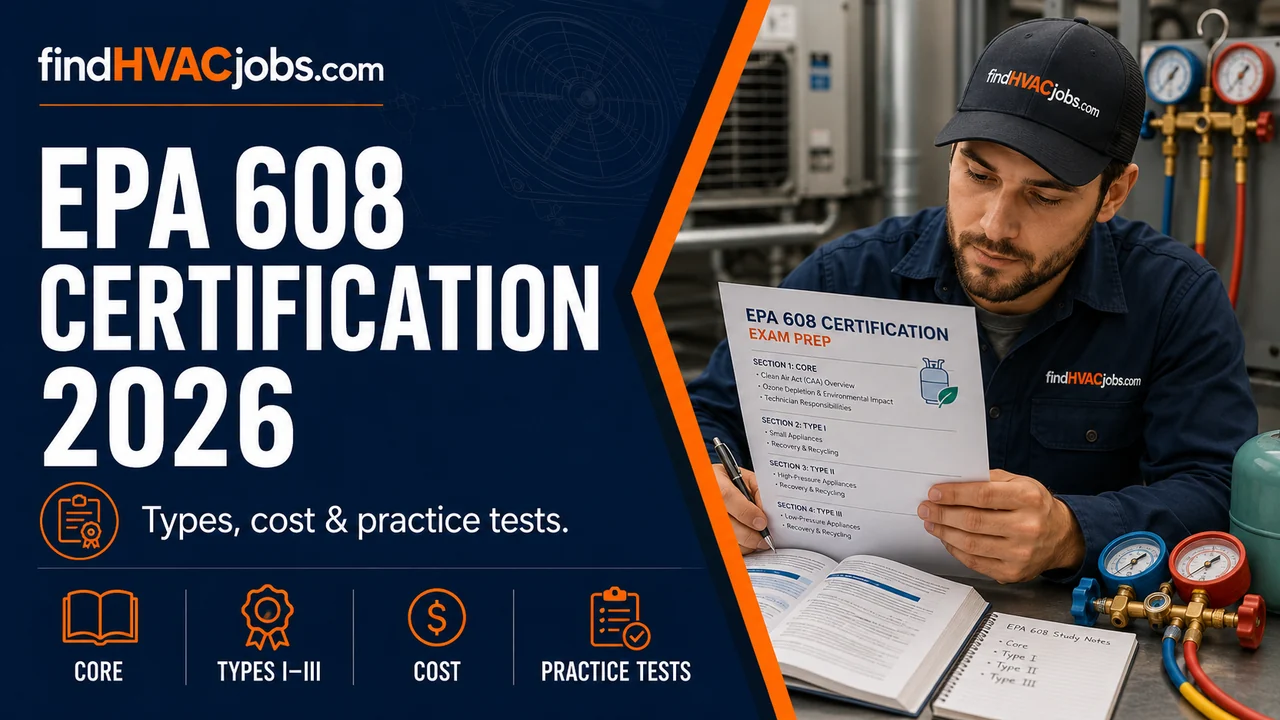
EPA 608 is the federal certification you need to legally handle refrigerant on stationary HVAC and refrigeration equipment. If you plan to service AC systems, heat pumps, or commercial refrigeration, this is step one. The good news: it does not expire, and most career-track techs are best served by earning Universal certification so they are not boxed into one equipment type.
There are four certification paths: Type I, Type II, Type III, and Universal. The exam has a Core section plus type-specific sections, and tests must be administered by an EPA-approved certifying organization. EPA itself does not issue the card.
This certification matters even more in 2026 because the work is getting more technical. The Bureau of Labor Statistics projects HVACR employment to grow 8% from 2024 to 2034, with about 40,100 openings per year. At the same time, the industry is moving toward lower-GWP refrigerants like R-454B and R-32, so new technicians need a strong refrigerant-handling foundation from day one. If you want a broader view of where the trade is headed, our HVAC technician salary guide breaks down pay by role, state, and certification.
EPA Section 608 certification comes from the Clean Air Act. It applies to technicians who maintain, service, repair, or dispose of equipment that could release refrigerant into the atmosphere. In plain English: if your job involves opening a system with refrigerant in it, you need this credential first.
It is also the certification tied to the federal rules around refrigerant recovery, recycling, reclaim, venting prohibitions, and safe handling. The exam covers both environmental rules and field knowledge, which is why employers treat it as a baseline credential rather than a nice-to-have.
One important exception: EPA 608 is not for car AC work. Motor vehicle air conditioning uses Section 609, not Section 608.
You need EPA 608 certification if you work on stationary HVAC or refrigeration equipment and your work can open the refrigerant circuit. That includes most residential service technicians, commercial HVAC technicians, refrigeration mechanics, supermarket techs, and chiller specialists. If you are still figuring out the path into the trade, our guide on how to become an HVAC technician walks through where 608 fits alongside trade school, apprenticeships, and state licensing.
You may not need every type. A tech who only works on factory-sealed small appliances has very different needs than a commercial service tech or a chiller mechanic. That is why EPA splits the credential into four categories.
For most job seekers, the safest move is Universal certification. It removes restrictions, looks stronger on a resume, and keeps you from having to retest when your job scope expands.
Here is the quick reference before we go deeper:
Type I: Small appliances under 5 lbs of refrigerant (window units, fridges, vending equipment). Narrowest scope. Best for appliance repair only.
Type II: High-pressure systems including most residential split systems, heat pumps, and rooftop units. The most common certification HVAC techs hold.
Type III: Low-pressure systems, mainly chillers. Specialized: used in hospitals, universities, and large commercial plants.
Universal: All three types combined. Recommended for anyone planning a long HVAC career.
Type I covers small appliances with 5 pounds or less of refrigerant that are typically factory sealed. Think window AC units, household refrigerators, freezers, dehumidifiers, and some vending equipment.
This is the lightest-duty certification. It can make sense for entry-level workers in appliance repair or for students getting started, but it is usually too narrow for a full HVAC career.
Type II is the most common certification for HVAC technicians. It covers high-pressure and very-high-pressure appliances, excluding small appliances and motor vehicle AC. That includes most residential split systems, heat pumps, rooftop units, and a large share of commercial systems. Most of the HVAC service technician roles on findHVACJobs.com require either Type II or Universal as the minimum.
If you want to work in residential service, installation, light commercial, or most general HVAC roles, this is often the minimum certification employers expect to see. It also pairs naturally with state-level HVAC license requirements, which usually layer on top of EPA 608.
Type III covers low-pressure appliances, mainly large chillers. This is a more specialized path used in bigger commercial and institutional settings.
Most beginners will not start here, but it matters if you want to work in hospitals, universities, industrial facilities, or large commercial buildings with central plants.
Universal certification means you passed Core plus Type I, Type II, and Type III. This is the best option for most HVAC students and job seekers because it covers the full range of stationary equipment. EPA notes that the Core test must be proctored to count toward Universal certification.
If you are deciding between Type II and Universal, Universal is usually the better long-term value. Apprentices in registered programs typically test for Universal as part of their classroom training.
The exam is split into the Core section plus one or more type sections. EPA's official test-topic outline includes ozone depletion, the Clean Air Act, the Montreal Protocol, venting prohibitions, refrigerant recovery, substitute refrigerants, leak detection, dehydration, safety, and shipping cylinders.
Mainstream Engineering, one EPA-approved provider, describes its Universal exam as 100 multiple-choice questions total: 25 Core, 25 Type I, 25 Type II, and 25 Type III, with a 3-hour time limit for the online-proctored format.
Topics tested across the four sections include:
EPA does not give the exam directly. You take it through one of several approved certifying organizations. The biggest names are:
If you are an apprentice, your sponsor likely runs 608 testing in-house. Our HVAC apprenticeship guide covers what is typically included in registered programs.
Online-proctored testing is fine for the Core, Type I, and Type II sections for most candidates, but some employers and state licensing boards prefer the in-person version. If you are testing in a state with strict licensing, like Texas, Florida, or California, check what your state board accepts before scheduling online.
The real answer in 2026 is that it depends on the provider and format.
Low-cost Type I options still exist. Mainstream Engineering lists its online open-book Type I exam at around $26.95 for the first attempt. On the higher end, ConSol lists $150 per certification type and $175 for Universal, with course access, study guides, practice tests, and multiple proctored exam attempts included. Pricing is fairly consistent across states. What changes is the licensing fees stacked on top of EPA 608, and those vary widely between markets like Hawaii, Delaware, and Texas.
A realistic way to frame your budget:
If you are career-focused, the better question is not "What is the cheapest exam?" It is "What gets me certified fast and prepared enough to pass?" A $27 exam is only cheap if you pass. Compared to the pay bump certified techs earn over uncertified workers, even the $175 Universal package pays for itself in the first week of a real job.
EPA 608 is a lifetime credential. It does not expire.
That does not mean you can stop learning. The credential stays valid, but the equipment, refrigerants, tools, and code environment keep changing. In 2026, that is especially true because of the shift away from R-410A in new equipment and the growing use of lower-GWP refrigerants like R-454B and R-32.
Already 608-certified? Browse current openings on findHVACJobs.com. Most listings flag the certifications employers want before you apply.
The biggest thing to understand is this: EPA 608 is still the baseline federal refrigerant credential. But the systems you work on are changing fast.
EPA's Technology Transitions rules pushed the market toward refrigerants with a global warming potential (GWP) of 700 or less in many new comfort-cooling applications starting in 2025. That is the main reason R-410A is being replaced in new systems by lower-GWP options like R-454B and R-32.
There is also a leak-repair compliance layer under the AIM Act. Since January 1, 2026, owners, operators, and certified technicians have been required to comply with leak repair requirements for certain appliances with a 15-pound or greater charge of refrigerant containing an HFC or specific substitutes.
For job seekers, the takeaway is simple: passing EPA 608 is still step one, but employers increasingly value technicians who also understand A2L refrigerant safety. A2Ls are mildly flammable, so leak detection, electrical clearances, and PPE practices around them differ from what techs are used to with R-410A. Expect more questions about A2Ls on updated test banks, and expect more employers to ask about A2L familiarity in interviews. Many techs follow up EPA 608 with a NATE certification for an additional resume bump and pay bump, especially in markets like Colorado and North Carolina where commercial demand is strong.
Many people underestimate the Core section because it sounds basic. It is not. Core is where most test-takers get tripped up because it mixes environmental rules, safety, definitions, and service practices.
Study Core first, then move into the type sections. If you fail Core, your type scores do not count.
Do not only memorize flash cards. Understand why recovery rules differ by equipment type, why low-pressure systems behave differently, and why venting rules exist. EPA's official test topics are broad enough that question wording can vary widely.
If you only have time for one type and you are aiming for standard HVAC service work, Type II usually gives you the most job-market value. It is what most residential and light commercial employers want to see.
Providers like ConSol include unlimited practice tests, and Mainstream offers study manuals. The repetition matters more than the source. If you can answer 80%+ on practice exams across all four sections, you are ready for the real thing.
EPA 608 is not a separate "R-410A certification" or "R-454B certification." EPA explicitly says certification is based on the type of appliance, not on a single refrigerant. But to be job-ready in 2026, you should also understand the move toward lower-GWP refrigerants and A2L safety. That is what employers will ask about even if the test does not.
A few patterns show up over and over:
These are exam-style multiple-choice questions covering Core, Type I, Type II, and Type III. Answers and brief explanations follow each question.
1. (Core) Knowingly venting refrigerant during the maintenance, service, or disposal of refrigeration equipment is:
Answer: C. The Clean Air Act prohibits knowingly venting class I and class II refrigerants and most non-exempt substitutes. Only de minimis releases during good-faith service activities are permitted.
2. (Core) Which international agreement led to the global phase-out of CFCs and HCFCs?
Answer: C. The Montreal Protocol, signed in 1987, set the international framework for phasing out ozone-depleting substances.
3. (Core) "Recovery" of refrigerant means:
Answer: B. Recovery is the simplest of the three R's: just removing refrigerant. Recycling cleans it on-site for reuse. Reclaim is full reprocessing to ARI 700 purity standards, typically off-site.
4. (Core) Which of the following is true about EPA 608 certification?
Answer: D. EPA 608 is a lifetime credential. The exam itself is administered by EPA-approved certifying organizations, not EPA directly.
5. (Type I) Type I certification covers appliances charged with how much refrigerant?
Answer: A. Type I covers small appliances containing 5 pounds or less of refrigerant, typically factory-sealed equipment like window units, refrigerators, and vending machines.
6. (Type II) When recovering refrigerant from a high-pressure appliance for disposal, what level of evacuation is required?
Answer: C. EPA sets specific recovery levels (in inches of mercury or psig) that depend on the appliance category and whether recovery equipment was manufactured before or after November 15, 1993.
7. (Type II) Since January 1, 2026, AIM Act leak repair compliance applies to appliances with what minimum refrigerant charge?
Answer: B. The AIM Act leak repair rules apply to appliances with a charge of 15 pounds or greater that contain HFCs or certain substitutes. Owners, operators, and certified technicians must all comply.
8. (Type II) R-454B is classified as which ASHRAE refrigerant safety class?
Answer: B. R-454B and R-32 are both A2L refrigerants: non-toxic but mildly flammable. This is why service tools, leak detection, and PPE practices have shifted for newer equipment.
9. (Type III) Which characteristic best describes a low-pressure refrigeration system?
Answer: A. Low-pressure refrigerants such as R-123 and R-514A have boiling points above 50°F at atmospheric pressure. The system's low side often runs at or below atmospheric pressure during normal operation.
10. (Type III) The biggest service risk on a low-pressure system is:
Answer: B. Because the low side runs at or below atmospheric pressure, air (with moisture) can leak inward. That contaminates the refrigerant, hurts efficiency, and can form acids inside the system over time.
If you can answer 8 of 10 of these confidently and explain why, you are in a good place to take the exam.
Do you need EPA 608 certification to become an HVAC technician?
If your job involves servicing or disposing of stationary equipment that contains refrigerant, yes, you typically need EPA 608. State licensing usually layers on top.
What is the best EPA 608 certification for beginners?
Universal. It covers all three equipment categories, removes scope restrictions on what you can work on, and looks stronger on a resume than any single type. Most apprenticeship sponsors and trade schools target Universal for that reason. If you are still mapping out the trade, the career guide for new HVAC technicians shows where 608 fits across the apprentice → journeyman → master path.
How hard is the EPA 608 exam?
It is passable but not a joke. The people who struggle most are usually the ones who underestimate the Core section or rely only on memorization. With current study materials and ~10 hours of focused prep, most candidates pass on the first attempt.
Can you take the EPA 608 exam online?
Yes. EPA-approved organizations like Mainstream Engineering and ESCO Institute offer remote-proctored exams. Some state boards still prefer in-person testing for licensing purposes, so check your state's HVAC licensing rules before scheduling.
What is the difference between EPA 608 and EPA 609?
EPA 608 covers stationary HVAC and refrigeration equipment. EPA 609 covers motor vehicle air conditioning. They are separate credentials issued under different sections of the Clean Air Act.
Do you need a new EPA certification for R-454B or R-32?
No separate EPA certification exists for those refrigerants. EPA's certification is based on the type of appliance, not a single refrigerant. But employers may still want technicians who understand A2L safety and newer low-GWP systems.
What happens if you lose your EPA 608 card?
Start with the organization that issued it. Approved certifying organizations keep records. If the original issuer cannot verify your certification, you may need to retest.
EPA 608 is one of the highest-ROI credentials you can earn early in an HVAC career. It is federally recognized, it does not expire, and it is required for a wide range of refrigerant work. For most people, the move is straightforward: go for Universal, study Core harder than you think you need to, and use current materials that reflect 2026 refrigerant realities.
Once you have your card, the work starts. Browse current HVAC openings on findHVACJobs.com. Listings flag the certifications employers want, so you can match your 608 type to the right roles before you apply.
