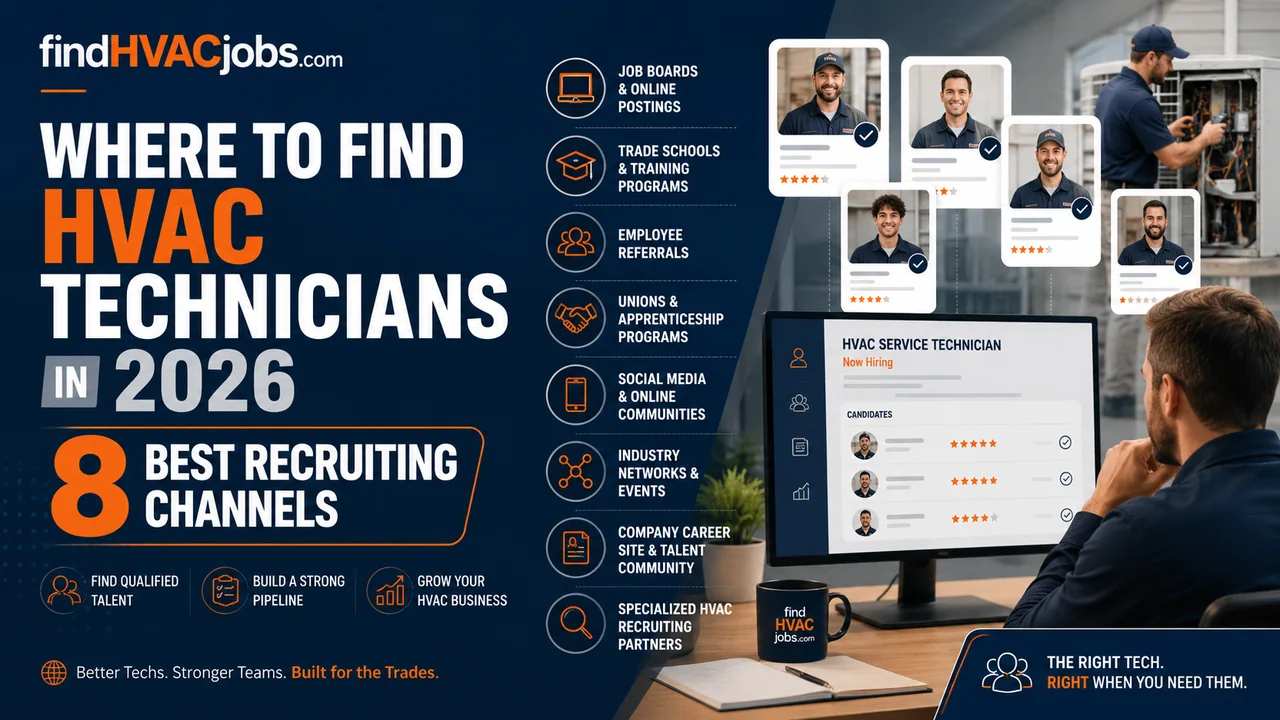
If you’re trying to figure out where to find HVAC technicians, start with three channels: a niche HVAC job board, your own referral network, and a local training pipeline. That combination usually gives you the best mix of speed, applicant quality, and cost.
The hard part is that HVAC hiring is tighter than it used to be. Industry research points to roughly 110,000 unfilled HVAC technician positions nationwide, while May 2025 BLS data (the most recent available) shows a national median wage of $62,940/year for HVAC mechanics and installers. That means qualified techs have options, and employers need a recruiting plan that goes beyond posting one ad and hoping for the best.
Below are the 8 best recruiting channels for HVAC employers, ranked by overall usefulness in 2026.
If you want the shortest path to qualified applicants, start with a niche HVAC job board. General platforms give you reach. Niche platforms give you relevance.
That matters in HVAC because the signal-to-noise problem is real. Niche boards tend to outperform generalist boards on applicant quality and speed, with time to first qualified lead as fast as 12–48 hours versus 3–7 days on broader job boards. That’s a meaningful difference when a truck is sitting empty.
Best for: Small to midsize HVAC companies, regional contractors, and employers who want faster screening.
Cost: Usually flat-rate or fixed-package pricing. Easier to budget than pay-per-click or pay-per-application models.
Speed: Fast. Often the fastest digital option.
Pros: Better applicant quality, less recruiter time wasted, stronger local visibility for HVAC-specific searches.
Cons: Smaller total audience than Indeed or ZipRecruiter.
A niche board also fits how HVAC candidates actually search. A technician looking for a better service role in Phoenix or a commercial refrigeration opening in Dallas is more likely to trust a platform built for the trade than one stuffed with unrelated jobs.
If you want a cleaner funnel than general job boards, post your opening on findHVACJobs.com and get in front of HVAC professionals instead of broad, low-intent traffic.
Trade schools are one of the best places to find apprentice-level and early-career HVAC talent. They are not the fastest channel for an emergency hire, but they are one of the best long-term recruiting channels you can build.
The big advantage is relationship depth. Schools, community colleges, and technical institutes give you access to students before they hit the open market. In many cases, that means shop tours, internship pipelines, instructor referrals, and first access to graduating classes.
Best for: Apprentice hiring, install teams, growth markets, and companies willing to invest in training.
Cost: Low. Mostly time, local outreach, and occasional sponsorship or equipment support.
Speed: Medium. Best when you recruit ahead of graduation cycles.
Pros: Reliable entry-level pipeline, stronger retention potential, easier culture fit.
Cons: Not ideal for urgent senior-level hires.
If you’re hiring in fast-growth states like Texas, Florida, or Arizona, school partnerships matter even more. Those markets need a steady flow of new talent, not just one-off hires. For a deeper look at the training landscape and what to expect from new grads, see our HVAC apprenticeship guide.
A good rule: don’t just email career services when you need somebody. Show up before you need somebody.
If you need experienced labor for commercial, industrial, sheet metal, piping, or large project work, union hiring halls should be on your list. For many contractors, they are the fastest way to access trained, pre-vetted labor at scale.
The two main channels here are the UA (United Association) and SMART (Sheet Metal, Air, Rail and Transportation Workers). The benefit is simple: you’re tapping into a workforce that has already gone through structured apprenticeship and ongoing training.
Best for: Union signatory contractors, commercial firms, industrial work, and larger project staffing.
Cost: Moderate. Tied to signatory relationships and labor agreements.
Speed: Fast. In some cases, staffing can happen within 24 hours.
Pros: Strong training standards, scalable labor access, reduced screening burden.
Cons: Not relevant for every contractor, especially non-union residential shops.
This is not the right answer for every HVAC company. But if you’re bidding larger work and need predictable labor quality, union halls can solve a problem that job ads alone usually cannot.
Referral programs are still one of the best ways to find HVAC technicians. In many companies, they produce the best hires because your current team does the first round of filtering for you.
Best-in-class teams get 30–35% of external hires through referrals. Bonus amounts have also climbed. In HVAC specialized roles, referral payouts often land between $1,500 and $3,000, with some employers going higher for tougher roles.
Best for: Any HVAC company with a stable team and decent culture.
Cost: Moderate. Usually much cheaper than a bad hire or an agency fee.
Speed: Medium. Stronger when you keep the program running year-round.
Pros: High applicant quality, better culture fit, higher retention potential.
Cons: Limited by the size and quality of your current team.
The structure matters. Split the bonus into two payments, usually at hire and after 90 or 180 days. That keeps the referring employee invested in onboarding and retention, not just the introduction.
If your referral bonus is still $500, you’re probably behind the market. For a full breakdown of what recruiting actually costs across every channel, see our guide to the true cost of hiring an HVAC technician.
Use referrals to bring in warm leads, then list your openings on findHVACJobs.com to widen the funnel without dumping your budget into low-quality applications.
Indeed, ZipRecruiter, and other general job boards still have a place in HVAC recruiting. They are useful when you need reach. They are less useful when you need precision.
That’s the tradeoff. You can get a lot of applicants fast, especially for apprentices, helpers, warehouse roles, or entry-level positions. But you also get more noise, more duplicate applicants, and more time wasted reviewing people who have never worked in HVAC.
Best for: Top-of-funnel volume, apprentice roles, admin support, and broad local awareness.
Cost: Medium to high once recruiter time and filtering are included.
Speed: Medium. Faster for volume, slower for real quality.
Pros: Massive reach, easy to launch, familiar to employers.
Cons: Lower applicant quality, higher screening burden, weaker conversion to qualified hires.
General boards are better as a secondary channel than a primary one. Use them to add reach. Don’t rely on them to do all the work.
If you do use Indeed, tighten the screening. Ask about field experience, refrigerant certification, valid driver’s license status, and specific system exposure before candidates can apply. For more on screening and job description structure, see our guide on how to hire HVAC technicians.
LinkedIn is not where most residential service techs spend their day job hunting. But it is still useful for passive recruiting, especially for lead technicians, project managers, estimators, sales roles, and building automation talent.
Its strength is not volume. Its strength is targeted outreach and employer branding. You can search for candidates by skill set, engage passive talent, and show what it’s like to work at your company.
Best for: Lead techs, managers, sales, estimators, BAS, and passive candidates.
Cost: Medium. Usually time plus optional paid promotion or recruiter tools.
Speed: Medium. Better for building a pipeline than filling tomorrow’s hole.
Pros: Good for passive talent, better for professional roles, strong branding channel.
Cons: Less effective for field-heavy volume hiring, Easy Apply can create noise.
Facebook and Instagram also matter more than some owners think. A simple feed of real trucks, real installs, team wins, and short tech spotlights can do more for recruiting than polished corporate copy.
Show the job. Show the team. Show the path to advancement.
Career fairs work best when you treat them like a local relationship channel, not just a one-day hiring event. They give you face time with students, early-career techs, and HVAC professionals who actually care enough about the trade to show up.
National shows like AHR Expo and the ACCA conference are high-signal environments, but they are expensive. Local school fairs, supply-house events, and community college career days are often a better fit for smaller HVAC companies.
Best for: Local market hiring, employer branding, school partnerships, and apprentice recruiting.
Cost: Moderate to high, depending on the event.
Speed: Event-based. Strongest when paired with follow-up.
Pros: Real conversations, faster personality screening, stronger local brand presence.
Cons: Limited geography, more time-intensive, hard to scale.
If you’re a 10-person shop, start local. You do not need a giant trade-show budget to make this channel work.
Staffing agencies can help when the role is urgent, specialized, or both. They can also get expensive fast.
In most cases, agencies should be the last channel you use, not the first. They make the most sense when you’ve exhausted your own pipeline, the truck cannot stay vacant, or the role is too specialized for your internal team to source efficiently.
Best for: Hard-to-fill senior roles, urgent backfills, project ramp-ups, and niche specialties.
Cost: High. Often 15–25% of first-year salary for direct hire.
Speed: Fast when the agency already has relevant candidates.
Pros: Saves internal time, useful for urgent or specialized roles, lowers sourcing burden.
Cons: Expensive, inconsistent quality between agencies, less employer-brand control.
If you use an agency, track the result hard. Don’t just ask whether they filled the seat. Ask whether the hire stuck.
Most HVAC employers do not need eight recruiting channels. They need the right three.
Here’s a practical way to think about it:
If your current strategy is “post on Indeed and wait,” you’re probably overpaying for weak signal. The better approach is to build one fast channel, one long-term pipeline, and one relationship-driven channel you control.
If you want the simplest answer to where to find HVAC technicians in 2026, start with a niche HVAC job board, then build out referrals and local training relationships behind it. That gives you speed now and a pipeline later.
The companies that hire best in this market are not using one channel. They’re building a system.
Ready to hire? Post your job on findHVACJobs.com and get in front of HVAC professionals without wasting time on broad, low-quality traffic. Then pair that listing with referrals and a local school pipeline to build a stronger bench.
For most employers, the best place to start is a niche HVAC job board. It usually gives you a better mix of relevance, speed, and applicant quality than broader platforms. Referrals and trade school relationships are strong second and third channels. See how posting on findHVACJobs.com works.
For qualified HVAC applicants, they usually are. Indeed gives you more volume, but niche boards tend to give you cleaner traffic and less screening work. The right move for many employers is to use niche first and general boards second.
A competitive HVAC referral bonus is often $1,500–$3,000 for technician roles. Harder-to-fill positions may justify more. Split payments usually work better than one lump sum. For more context on hiring economics, see our cost of hiring an HVAC technician guide.
Yes. Trade schools are one of the best long-term pipelines for apprentice and early-career hiring. The employers who get the most from them build relationships before they have an urgent opening. Markets like North Carolina, Texas, and Florida have deep school networks worth mapping out.
Use an agency when the role is urgent, specialized, or difficult to fill through your own channels. For most routine technician hiring, agencies are too expensive to use as your first option.
Yes, but mostly for management, estimating, building automation, sales, and passive talent. It is less effective as a primary source for field-tech volume hiring.
A niche job board, a warm referral, or a union hiring hall is usually the fastest route. General boards can move quickly too, but they often create more screening work before you find someone qualified. Start your job post here.
