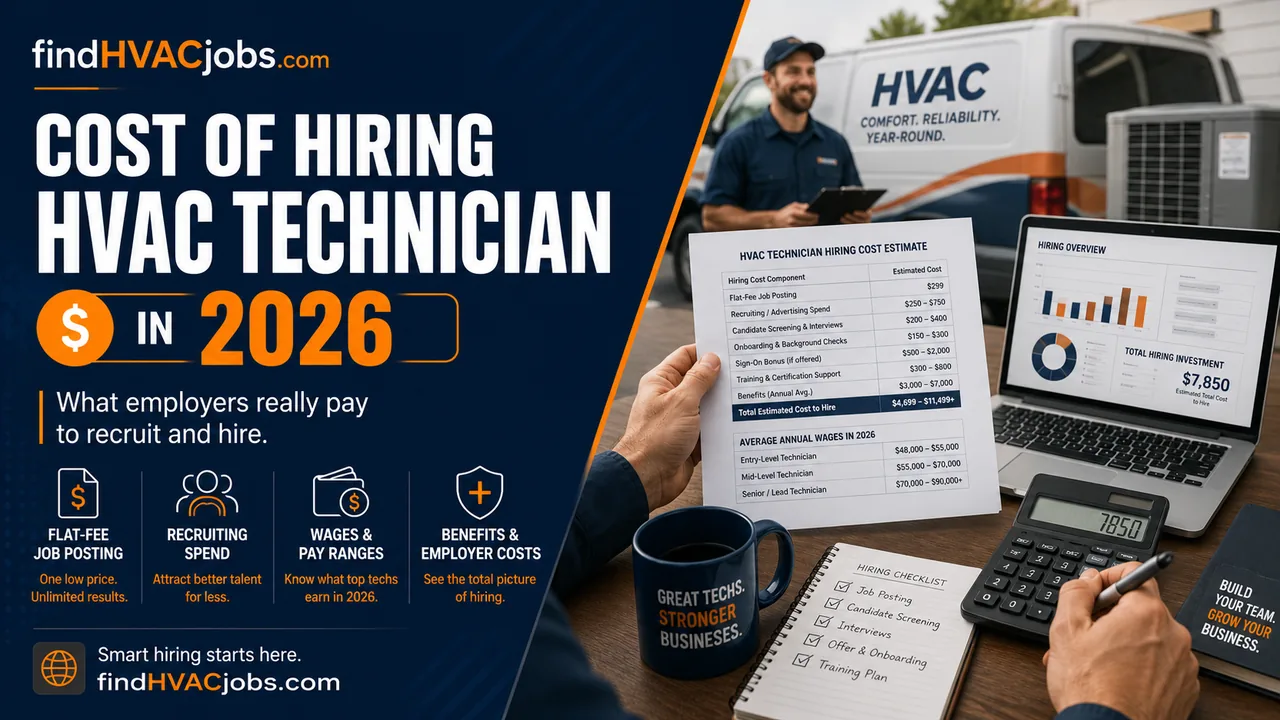
The cost of hiring an HVAC technician in 2026 is usually much higher than the job post itself. SHRM's 2025 benchmarking report puts the average non-executive cost-per-hire at $5,475, but HVAC employers routinely spend well beyond that once you add screening time, vacancy cost, onboarding, and bad-hire risk. In a tight trade labor market, the real question is not "What did the job board cost?" It is "What did this hire cost all-in?"
That matters because HVAC hiring is not happening in a soft, low-skill labor market. The Bureau of Labor Statistics (BLS) projects 8% employment growth for HVAC technicians from 2024 to 2034, with about 40,100 openings per year on average over the decade. More demand means more competition, faster offer windows, and higher recruiting costs for employers that move slowly or lean on broad, low-intent channels.
If you want a clean benchmark, start with the $5,475 SHRM figure for non-executive roles. That is a cross-industry number. Skilled-trades hiring typically lands in the mid-four figures to low five figures, and HVAC can move past $12,000 all-in once you count training, supervision, tools, and lost productivity.
For a small or mid-sized HVAC company, the biggest mistake is comparing channels by sticker price alone. A "cheap" post that produces 35 unqualified applications is often more expensive than a higher-intent source that sends five real HVAC professionals. The goal is not the lowest invoice. The goal is the lowest cost per qualified applicant, benchmarked against what your market actually pays an HVAC technician.
Here is the practical breakdown most HVAC employers care about. Platform pricing shifts by market and by season, so verify each vendor's current page before committing to a plan.
Indeed. Indeed runs a budget-based sponsored model with no flat upfront fee. You set a daily or monthly budget and pay either per click or per started application, depending on budget type and market. Sponsored posts start at a $5/day or $150/month minimum. The catch for HVAC is intent. Broad traffic can generate $15 to $30 per application in screening waste, which turns into $600 to $1,200 of cost before a single interview is booked.
ZipRecruiter. Subscription model with three tiers. Based on current third-party pricing data, Standard runs roughly $299 to $399 per month per job slot, Premium runs $419 to $519, and Pro runs $719 to $899. You get predictable monthly costs, but no guarantee of qualified HVAC applicants. Review sites show a recurring complaint from skilled-trades employers: high application volume, low relevance.
LinkedIn. Promoted job posts are budget-based, and Recruiter Lite runs about $170 per month with 30 InMails. LinkedIn makes sense for senior and management hiring: service managers, estimators, project managers, and commercial sales leaders. For everyday residential field hiring, the audience match is weaker and the cost per qualified applicant climbs fast. Pair it with a sharp HVAC job description and it can work well for the right roles.
Staffing agencies. Typical contingency fees run 15% to 25% of first-year salary. On a $60,000 technician, that is roughly $9,000 to $15,000. On harder-to-fill commercial or senior roles, the number climbs quickly. Useful when you need someone in a truck next week. Expensive as a default channel.
Niche HVAC job boards. Lower flat monthly pricing with a higher-intent audience and less screening waste, which makes them a better fit for field roles. Because every applicant is already an HVAC professional, cost per qualified applicant usually comes in well below generalist platforms. Our full hiring-channel comparison covers when each channel is worth using.
Indeed's model is flexible on paper. There is no flat upfront fee, and you can pay by click or by started application depending on budget type. That sounds efficient. It is not always efficient for HVAC.
The problem is intent. A service tech role on a general board attracts office admins, warehouse workers, and people who clicked because the pay looked decent. A common pattern plays out across Texas-sized markets and smaller regions alike: an employer pays $15 to $30 per application, gets 40 applications, and still has no one ready for a truck, a van stock check, or a call block. That is how a supposedly cheap post becomes a $600 to $1,200 screening project.
And that is before internal labor. If your service manager is digging through resumes, the spend is not just ad budget. It is time that should have been spent on dispatch, job costing, callbacks, or revenue work.
The posting fee is the visible cost. The expensive part is everything around it.
Hiring managers often spend roughly 60% of their recruiting time screening unqualified applicants. A service manager billing $150 per hour who spends 20 hours per month on hiring tasks represents $3,000 per month in opportunity cost, or about $6,000 across a typical 45-to-60-day hiring cycle. That is overhead that never shows up on an invoice.
An open seat is not just an inconvenience. It is an idle truck. If a technician would have billed 30 hours per week at $100 per hour, one vacancy costs about $3,000 per week in gross revenue. Stretch the cycle to 60 days and vacancy cost can move past $25,000. Shaving two weeks off the process saves roughly $6,000 before you factor in anything else.
The U.S. Department of Labor estimates a bad hire costs at least 30% of first-year salary. For a $60,000 HVAC technician, that is an $18,000 baseline before you add tooling, extra supervision, retraining, lost productivity, or customer damage.
In HVAC specifically, that risk is worse because the trade now carries more technical and equipment burden than it did even a few years ago. The A2L refrigerant transition alone has pushed new tooling investment into the $2,000 to $5,000 per truck range, on top of onboarding and certification costs such as EPA 608 that can add another $1,500 to $5,000. One bad field hire can quickly turn into a $30,000+ mistake.
This is where the economics get more interesting.
Generalist platforms typically produce qualification rates around 5% to 8% for HVAC roles. Trade-specific channels land closer to 20% to 25% because the audience is pre-filtered. That difference shows up as less screening time, fewer wasted interviews, and stronger one-year retention for hires sourced through specialized channels.
That does not mean every niche board post automatically wins. It means the cost equation is different. If an HVAC-only board sends fewer applicants but most of them already have EPA 608, real field experience, and the right expectations for the work, your real cost per qualified applicant drops fast.
The lowest invoice is not the lowest hiring cost. The lowest hiring cost is the channel that gets you to a qualified, stable technician with the least wasted manager time.
If you want to cut screening waste, post your role where HVAC professionals are already looking. Plans on findHVACJobs.com start at $29/month for a single job slot, so you can see the applicant quality before scaling up.
There is no magic source. There is a better sequence.
A structured referral bonus is often the cheapest quality source you have. A $1,000 to $2,000 bonus for a successful technician referral sits well under any staffing fee and usually carries lower culture risk. Most HVAC companies underuse this channel simply because they never formalize it.
If the role is a field technician, installer, refrigeration tech, or HVAC apprentice, start with HVAC-only channels. General boards can still help with reach, but they should not be your first move for a core field hire. Reserve them for top-of-funnel volume once your niche channel is already running.
LinkedIn works well for service managers, estimators, project managers, sales leaders, and harder-to-fill senior technical roles. It is not the best first channel for everyday residential or light commercial field hiring. In Sun Belt states like Florida and major metros like Houston, the field-tech profile density on LinkedIn is genuinely thin compared to the actual labor pool.
Qualified technicians often have multiple options within 48 hours. Reducing your process to a phone screen plus one structured interview can cut vacancy cost by 20% to 40%. If you wait a week to decide, you are often deciding after the market already did.
This is the metric HVAC owners should actually care about. A cheap post that sends junk traffic is expensive. A flat-fee source that produces real HVAC professionals is usually cheaper, even when the initial invoice looks higher.
In 2026, the cost of hiring an HVAC technician is not just a recruiting line item. It is a margin decision.
Start with the national $5,475 benchmark. Then add the HVAC reality: a labor shortage, technician competition, screening drag, vacancy loss, and the cost of a bad field hire. Once you run that math, the cheapest channel is almost always the one that gets you to a qualified technician fastest with the least wasted manager time.
For most HVAC employers, that means using broad platforms selectively, agencies only when necessary, and specialized HVAC channels much earlier in the process.
Want to lower your cost per qualified HVAC applicant? Post on findHVACJobs.com. Plans start at $29/month for a single slot, with multi-slot plans at $79 and $199 as you scale. Every applicant is an HVAC professional, no wading through generalist traffic.
The national benchmark is $5,475 per non-executive hire, based on SHRM's 2025 benchmarking report. In HVAC, the all-in cost is usually higher once you factor in screening time, vacancy cost, onboarding, and bad-hire risk. A realistic HVAC field technician hire lands between roughly $6,000 and $12,000+ depending on seniority and region, before you factor in any staffing fees. Our salary guide covers what that translates to in technician pay by state.
Not always. Indeed's sponsored pricing is budget-based with a $5/day or $150/month minimum, so the upfront invoice looks flexible. But if a listing attracts low-fit traffic, your cost per qualified applicant climbs quickly through wasted applications and manager time. Niche HVAC boards are frequently cheaper per qualified applicant even when the flat fee looks higher on paper.
Staffing agencies are usually the most expensive direct channel. Contingency fees run 15% to 25% of first-year salary, which means roughly $9,000 to $15,000 on a $60,000 technician before any extras. Worth it for urgent or hard-to-fill roles, expensive as a default. Our full hiring-channel guide ranks the realistic alternatives by cost and quality.
Because the talent pool is tight, the work is specialized, and the cost of a miss is high. BLS still projects 8% growth and 40,100 openings per year for HVAC technicians through 2034, which pushes wages and competition up. On top of that, HVAC carries trade-specific costs that general benchmarks miss: idle trucks, A2L tooling, onboarding, and customer risk on live service calls.
Start with referrals, move niche HVAC boards earlier in the process, save LinkedIn for senior and management roles, and shorten your interview loop. Track cost per qualified applicant instead of cost per post. The sequence that works in most HVAC shops: referrals first, niche HVAC board second, general platforms and agencies only as needed.
Cost is only one piece of the decision. For the full playbook, from sourcing candidates to keeping them past year one, see our guide on how to hire HVAC technicians.
