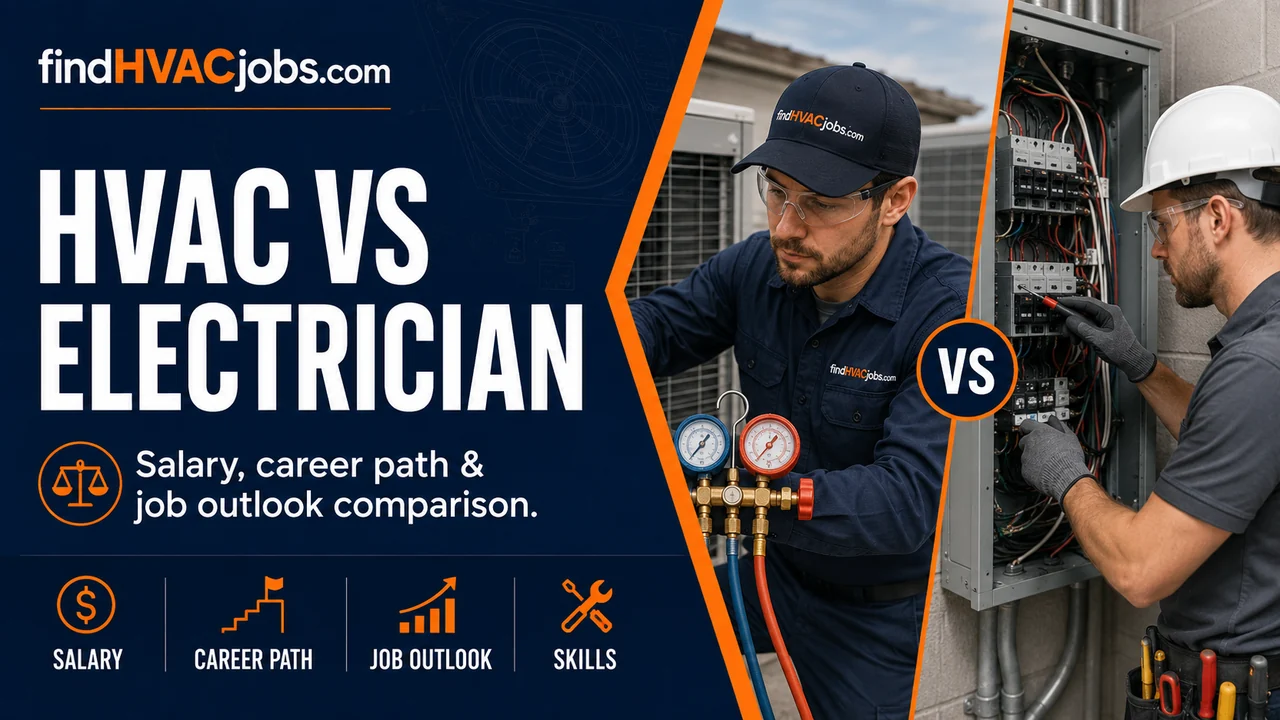
At the national median, the two trades are now nearly tied on pay. HVAC gets you into paid field work faster.
Both are strong skilled trade careers. Both pay well. Both are projected to grow much faster than the average U.S. occupation through 2034. They are not the same job, though, and the right one depends on what you want out of the work.
Here is the straight comparison, using May 2025 wage data from the Bureau of Labor Statistics (BLS), the most recent national wage data available.
Median annual pay: HVAC $62,940/year. Electrician $63,190/year.
Median hourly pay: HVAC about $30.26/hr. Electrician $30.38/hr.
Mean annual pay: HVAC $64,780. Electrician $71,490.
Job growth, 2024–2034: HVAC 8%. Electrician 9%. (Average for all occupations: 3%.)
Projected annual openings: HVAC about 40,100/year. Electrician about 81,000/year.
Typical training path: HVAC trade school plus on-the-job training (6 months to 2 years). Electrician 4- or 5-year apprenticeship (about 2,000 hours per year of paid work plus classroom).
Typical entry education: HVAC postsecondary nondegree award. Electrician high school diploma or equivalent.
Licensing: HVAC varies by state, plus EPA 608 for refrigerants. Electrician most states require a license.
Work style: HVAC service calls, installs, repairs, and seasonal maintenance. Electrician wiring, panels, controls, lighting, and construction.
Best fit: HVAC for mechanical problem-solvers who want variety. Electrician for detail-focused people who like code, wiring, and precision.
Wage figures: BLS Occupational Employment and Wage Statistics, May 2025. Growth and openings: BLS Employment Projections, 2024–2034.
The old rule was that electricians out-earned HVAC techs by a comfortable margin. The newest data mostly erased it.
According to BLS May 2025 data, the median annual wage for HVAC technicians was $62,940. Electricians earned $63,190. That is a gap of $250 a year, about 12 cents an hour. A year earlier the gap was roughly $2,500, so HVAC pay closed most of the distance in a single release.
Where the trades still separate is the average. Electricians earn a mean of $71,490 against $64,780 for HVAC techs, and that $6,710 difference comes almost entirely from the top of the electrical pay range: industrial, utility, and data center work pulls the average up.
A few hundred dollars at the median should not decide anything. Your state, employer, overtime, union status, certifications, and specialty each move the number more than the national gap does. A commercial HVAC tech working on refrigeration racks or building automation systems can out-earn a residential electrician. A union electrician on industrial or data center projects can out-earn most HVAC techs.
Pay also varies a lot by state. For a deeper breakdown by state and experience level, see our HVAC Technician Salary Guide 2026, or compare the top-paying HVAC markets like California, Alaska, and Washington.
The real question is not "which trade pays more?" The better question is which path gives you the kind of work, income, and schedule you actually want.
Both careers have strong demand through 2034.
BLS projects 8% job growth for HVAC technicians from 2024 to 2034, with about 40,100 openings per year. Electricians are projected to grow 9% over the same period, with about 81,000 openings per year. Both are well above the 3% average for all occupations.
Electricians have more total projected openings because the occupation is larger. Electrical work touches construction, utilities, manufacturing, renewable energy, EV charging, industrial maintenance, and residential service.
HVAC demand is different. It is heavily tied to heating, cooling, refrigeration, energy efficiency, replacement systems, and emergency service. That makes HVAC less dependent on new construction than many trades. Even when construction slows, AC units still fail, furnaces still need repair, and commercial refrigeration systems still need maintenance.
If you want to see where HVAC demand is strongest right now, check the city-level data on pages like Houston, TX, Phoenix, AZ, and Dallas, TX.
HVAC is often the faster path into paid field work.
BLS says HVAC technicians typically complete postsecondary instruction through trade schools or community colleges. These programs usually last 6 months to 2 years and lead to a certificate or associate degree. That does not mean you become a master tech in 6 months. It means you can learn the basics, get your EPA 608 certification, and become employable faster.
Electricians usually take longer. Most learn through a 4- or 5-year apprenticeship. Each year typically includes about 2,000 hours of paid on-the-job training plus classroom instruction in electrical theory, blueprint reading, math, code, and safety.
The longer electrical path has its own benefits. Electrical apprenticeships are structured, respected, and often low-cost. You earn while you learn. By the end, you have a clear route toward journey worker status and, eventually, master electrician roles.
If your goal is to change careers quickly, though, HVAC is the more practical starting point. See our HVAC trade school directory for programs near you, or read our HVAC apprenticeship guide for the apprentice path on the HVAC side.
Ready to see what HVAC actually pays in your state? Browse open HVAC jobs by location on findHVACjobs.com, or compare your local market on the HVAC Salary Guide.
Both trades come with licensing and certification requirements.
For HVAC, requirements vary by state. Some states license HVAC contractors at the state level. Others leave most requirements to counties or cities. One rule is national, though: if you handle regulated refrigerants, you need EPA Section 608 certification.
That matters because refrigerants are central to air conditioning and refrigeration work. HVAC techs also need to stay current as the industry moves away from higher-GWP HFCs. Under the AIM Act, the EPA is restricting the use of higher-GWP HFCs in several refrigeration, air conditioning, and heat pump categories, with major restrictions that took effect January 1, 2025.
For electricians, licensing is usually more formal. Most states require electricians to pass a test and get licensed. Those exams often cover the National Electrical Code plus state and local electrical codes.
Bottom line: HVAC can be easier to enter, but the rules vary more by state. Electrical licensing is often more standardized, but the path usually takes longer. For HVAC-specific requirements, see our HVAC license requirements by state guide and our EPA 608 certification guide.
HVAC technicians work on systems that heat, cool, ventilate, and refrigerate buildings.
A typical HVAC tech may deal with split systems, furnaces, heat pumps, condensing units, evaporator coils, refrigerant circuits, ductwork, controls and thermostats, commercial rooftop units, and refrigeration systems.
HVAC work is highly diagnostic. A tech may need to figure out whether the problem is electrical, mechanical, airflow-related, refrigerant-related, or caused by poor installation. It is also customer-facing. Residential HVAC techs often work in occupied homes, explaining repairs, discussing replacement options, and handling emergency calls when the AC goes out in July or the heat fails in January.
BLS notes that HVAC technicians may work in cramped spaces, outdoors, or in extreme temperatures. They may also work evenings, weekends, overtime, and on-call shifts during peak heating and cooling seasons.
That is the tradeoff. HVAC gives you variety and independence. The work can be hot, dirty, seasonal, and physically demanding.
Electricians install, maintain, and repair electrical power, lighting, communications, and control systems.
That work can include running wire, installing panels, reading blueprints, bending conduit, installing lighting, troubleshooting circuits, working with transformers and breakers, setting up controls, and supporting solar, EV charging, and industrial systems.
Electrical work is often more code-driven than HVAC. You need to know what is allowed, what is safe, and what will pass inspection.
It can also be dangerous. BLS notes that electricians face risks from electrical shock, falls, burns, and other injuries. They may also work at heights, in cramped spaces, outdoors, or around dirt, dust, fumes, and noise.
Compared to HVAC, electrical work is often viewed as cleaner and more precise. That is not always true on a construction site, but it is fair to say electricians deal with fewer filters, condensate pans, refrigerant lines, and failed blower motors.
At the high end, electricians have the stronger W2 ceiling.
The means tell the story. Electricians average $71,490 a year against $64,780 for HVAC techs (BLS, May 2025), even though the medians sit only $250 apart. When an occupation's average runs that far above its midpoint, the top of the pay range is doing the pulling. For electricians, that top end runs through industrial electrician, controls electrician, utility work, data center projects, electrical foreman, project manager, master electrician, and electrical contractor roles.
HVAC still has strong upside, especially for techs who specialize. High-paying HVAC paths include commercial refrigeration, building automation systems, industrial HVAC, chillers and boilers, cleanroom HVAC, supermarket rack systems, HVAC sales, service management, and HVAC business ownership.
A strong commercial HVAC tech can clear six figures in the right market. Across the whole occupation, though, electricians carry the heavier top end.
HVAC schedules often follow the weather.
Summer heat drives AC calls. Winter cold drives heating calls. Shoulder seasons can be slower, especially in residential service. That creates a feast-or-famine rhythm in some markets. You may work long weeks during extreme weather, then see hours normalize in spring and fall.
Electricians can still work overtime, nights, weekends, and emergency calls. But many electrical jobs are tied to planned construction, maintenance, or installation schedules. That can make the work feel more predictable, especially in commercial or industrial roles.
If schedule stability matters most, electrician may have the edge. If you like service calls, variety, and a different problem every day, HVAC fits better.
HVAC is often better for career changers who want to get into the field quickly.
A 6- to 12-month HVAC certificate can prepare you for helper, apprentice, installer, or entry-level technician roles. You still need field experience, but the runway is shorter. Read our full how to become an HVAC technician guide for the step-by-step path.
Electrician is often better for people who want a longer, more structured career track. The apprenticeship path takes more time, but it gives you a strong license-based ladder from apprentice to journey worker to master.
Choose HVAC if you want faster entry into the field, more mechanical variety, heating, cooling, and refrigeration work, a mix of electrical-mechanical-customer-service problems, and a path into service management or business ownership.
Choose electrician if you want a more structured apprenticeship path, a heavier top-end wage range, code-heavy work, wiring-controls-power-infrastructure focus, and a path into industrial, utility, solar, EV charging, or project management roles.
The line between HVAC and electrical work is getting blurrier.
Heat pumps, inverter systems, smart thermostats, building automation, energy management systems, and connected equipment all require more electrical knowledge than older HVAC systems did. At the same time, electricians are getting pulled into HVAC-adjacent work through EV charging, solar, battery storage, load management, and energy controls.
The best HVAC techs of the next decade will understand more electrical theory. The best electricians will understand more mechanical systems, controls, and energy management.
That does not mean you need to master both trades. It does mean the most valuable people in either trade will be the ones who can troubleshoot across systems.
There is no bad choice here.
Electrician wins on total projected openings and top-end W2 earning potential. The trade has a strong licensing structure and a long runway into industrial, utility, EV, solar, and project management roles.
HVAC wins on speed to entry, day-to-day variety, and strong repair-and-replacement demand. The trade also just closed most of its historic median pay gap with electrical work. It is a strong fit for people who like mechanical troubleshooting, customer-facing service work, and the option to specialize in refrigeration, controls, heat pumps, or to own a service business.
The simplest answer: choose HVAC if you want to get into skilled trade work faster and like solving mechanical problems in the field. Choose electrician if you want a longer apprenticeship path, a heavier top-end wage range, and more code-driven electrical work.
Ready to explore the HVAC side? Browse open HVAC technician jobs, installer jobs, and apprentice jobs on findHVACjobs.com.
HVAC is not necessarily harder than electrical work, but it is different. HVAC can be more physically uncomfortable because techs often work in attics, crawl spaces, rooftops, and extreme temperatures. Electrical work carries more direct shock and arc-flash risk, so code compliance and safety habits are critical.
Electricians earn slightly more at the national median, but the gap has nearly closed. BLS May 2025 data shows electricians at a median of $63,190 per year and HVAC technicians at $62,940, a difference of $250. The real separation is in the averages: electricians earn a mean of $71,490 against $64,780 for HVAC, reflecting a heavier concentration of high-paying industrial and utility roles at the top of the electrical trade. Pay varies a lot by state, so see our HVAC salary guide for state-level breakdowns.
Yes. HVAC is a strong career in 2026 because demand is tied to heating, cooling, refrigeration, building efficiency, and replacement systems. BLS projects 8% growth from 2024 to 2034 and about 40,100 openings per year for HVAC technicians, well above the 3% average for all occupations.
Yes. Electrician is also a strong career in 2026. BLS projects 9% growth from 2024 to 2034 and about 81,000 openings per year. Electricians have strong long-term demand from construction, industrial work, utilities, renewable energy, and EV charging infrastructure.
Choose HVAC if you want a faster training path, more service-call variety, and mechanical troubleshooting. Choose electrician if you want a structured apprenticeship, a heavier top-end wage range, and code-focused work with wiring, power, and controls. For HVAC specifically, see our career path guide to get started.
Yes, but you would usually need to enter an electrical apprenticeship or meet your state's electrical licensing requirements. HVAC experience helps because HVAC techs already work with motors, capacitors, low-voltage controls, wiring diagrams, and electrical troubleshooting. But electrical licensing has its own separate rules.
Electricians can handle electrical components of HVAC systems, but that does not automatically make them HVAC technicians. HVAC work also requires knowledge of refrigeration cycles, airflow, combustion, duct systems, condensate management, and EPA refrigerant rules. Some contractors employ both trades because the skills overlap but are not identical.
Sources:
