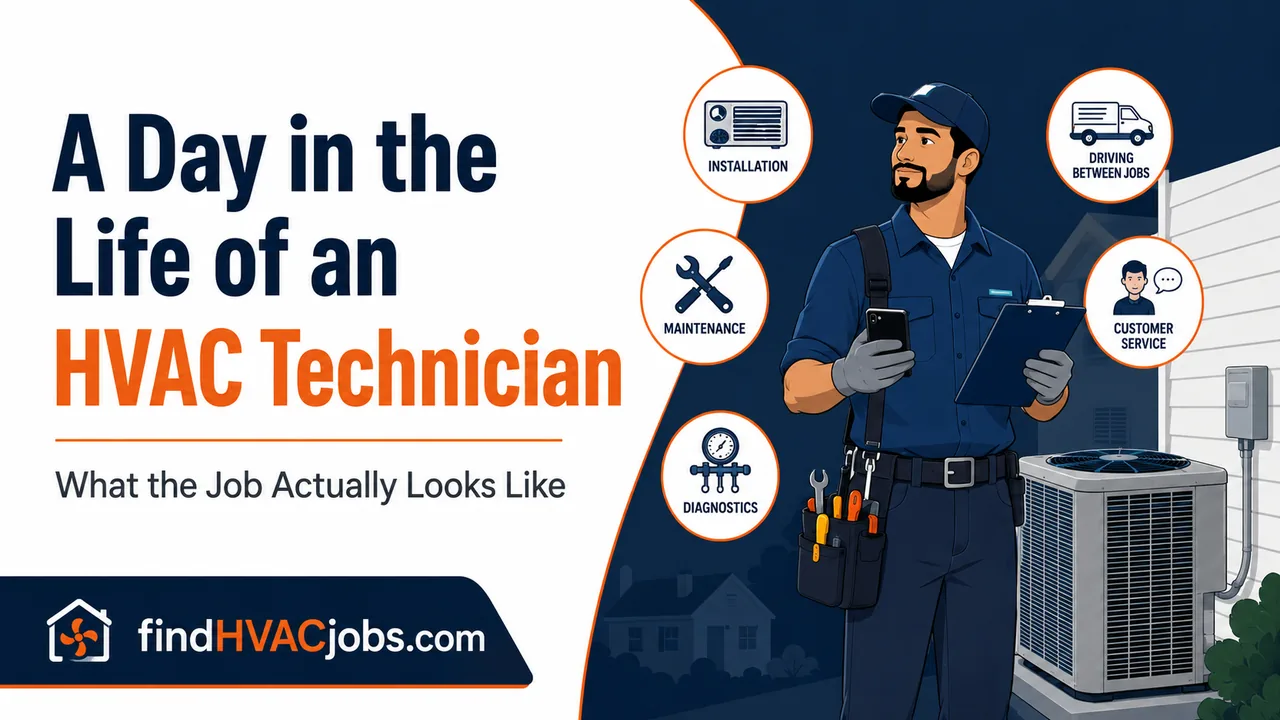
Most people picture an HVAC tech and think "the AC guy." The job is bigger than that, and the day starts earlier than you'd expect. Here's a real day in the life of an HVAC technician, followed through two people: Marcus, a residential service tech in Phoenix, and Ray, who runs commercial rooftops in Dallas. Same trade, two very different days.
The short version: early mornings, hands-on problem solving, and pay that climbs fast once you know what you're doing. National median pay for HVAC techs is about $62,940 a year, with the mean closer to $64,780 (BLS OEWS, May 2025 data). Get good, pick up overtime, and $90,000 is real money on the table.
Before the first call, both guys check their trucks. This isn't busywork. A tech who rolls up missing the one part he needs just burned an hour driving to a supply house, and the customer is sitting in an 84-degree living room watching him leave.
Marcus counts his capacitors first. It's the part that fails more than any other, so he keeps a dozen sizes stocked. Then contactors, a couple pounds of R-410A, condensate tablets, a hard-start kit or two. He's also got a coffee can full of 5/16 nut drivers, because he loses one on roughly every third job. Every residential tech does.
Ray's truck looks different. He's carrying belts, motor bearings, a spare blower motor, and his gauges, because commercial work means bigger equipment and fewer trips back down a ladder. He checks that his meter reads true before he pulls out of the shop.
Marcus gets his first dispatch at 7. No cool, single-story house, homeowner already frustrated because the system quit overnight.
He pulls the disconnect, pops the panel on the condenser, and meters the run capacitor. It's rated for 45 microfarads and reading 12. Dead. That's the most common no-cool call in summer, and it's a fifteen-minute fix. New cap in, disconnect back, compressor kicks on.
But he's not done. He climbs into the attic to check the air handler, and this is the part the brochures skip. It's 7:40 in the morning and the attic is already 130 degrees. In July it'll hit 150. He finds the condensate line clogged, which had tripped the float switch and shut the system down as a backup. He clears it, flushes it, drops in a tablet, and it drains clean.
Then he explains all of it to the homeowner in plain English, because a good tech doesn't talk down to the person paying the bill. Handling that refrigerant, by the way, is why every tech needs an EPA 608 certification before they're allowed to touch a system. It's the first credential most HVAC technician jobs ask for.
Commercial work runs on a different rhythm. Ray spends his morning on a preventive maintenance contract for a strip mall, which means rooftop units, one after another.
He checks amp draw on each compressor against the nameplate rating, listens for a blower belt that's glazed and squealing, greases bearings, and cleans the economizer dampers so they actually modulate. A black commercial roof in Dallas in July runs 20 degrees hotter than the air around it, and there's no shade up there.
Fewer customer conversations than Marcus has. More units per stop. Commercial techs deal with facility managers who want the report and the invoice, not a lecture. It's steadier work, usually on service agreements, and it opens the door toward installer and refrigeration roles as you specialize.
Ask a tech what they carry and you'll get a long answer. The short list: digital gauges for reading pressures, a solid multimeter (usually a Fluke, since electrical faults cause half the no-cool calls), a recovery machine, a vacuum pump, and a micron gauge for pulling a proper vacuum. Add nitrogen for pressure testing, a leak detector, coil cleaner, and a truck stocked with the parts that fail: capacitors, contactors, fuses, float switches, and thermostats.
That micron gauge matters more than it looks. Pull a lazy vacuum and skip it, and you've left moisture in the system that turns into a callback in August. The details are the job. The full breakdown, brands and prices included, is in our HVAC technician tools list.
Pay in this trade is rarely one flat number. It stacks.
Base hourly: Entry-level helpers start around $18 to $24 an hour. An experienced service tech runs $30 to $45, higher in expensive markets.
Overtime: Time-and-a-half past 40 hours, and in peak summer there's plenty of it. This is where a lot of techs pad their year.
On-call pay: Most shops rotate on-call weeks. You get a stipend for carrying the phone plus per-call pay when you head out at 2 AM for a dead furnace.
Spiffs and commission: Residential shops often pay a bonus when you sell a needed repair, a maintenance membership, or a full system. Honest techs do fine here, because summer creates plenty of real work without inventing any.
Add it up and the national median lands near $62,940 a year (BLS, May 2025). By state it swings: Arizona averages about $60,900 and Texas about $59,130, while California runs to $75,370. In several states the top 10% of techs clear $90,000. In hot metros like Phoenix, Dallas, Houston, and Atlanta, summer overtime alone can add five figures. You can see the full picture on our HVAC salary guide.
This is where honesty matters, because the trade gets oversold sometimes.
The attic in July is genuinely brutal. So are crawlspaces, and so is a rooftop with no shade. On-call means your phone can ring at 2 AM in January for a no-heat call with a newborn in the house, and you're going. Callbacks sting, your pride and sometimes your paycheck. And twenty years of kneeling on concrete and hauling condensers up stairs adds up in your knees and lower back.
Some customers are rude. Some houses are filthy. You take the good with that.
If you're weighing this against another skilled trade, our side-by-side on HVAC versus electrician lays out the real tradeoffs.
Plenty of techs will tell you they'd never go back to sitting at a desk.
There's a real satisfaction in walking up to a dead system, tracing the fault, and hearing it roar back to life fifteen minutes later. No two days look the same. You run your own truck and your own calls, which is about as close to being your own boss as a paycheck job gets. The work can't be offshored or automated away, and the pay is real without a four-year degree or the debt that comes with it.
The ceiling is high, too. Techs move up to lead installer, foreman, service manager, or estimator, and plenty go on to start their own shop. A lot of shop owners started exactly where Marcus is standing right now.
Two main doors in. You can go through a trade school program, or you can start as a helper and learn through a paid apprenticeship. Both work, and both are covered step by step in our guide to becoming an HVAC technician.
Either way, get your EPA 608 certification early, since you can't legally handle refrigerant without it, and check your state's license requirements before you start. Then it's a matter of getting on a truck.
A typical day mixes diagnosing broken systems, making repairs, and preventive maintenance. A residential tech might run six to eight service calls in a day: bad capacitors, clogged drain lines, low refrigerant. A commercial tech may service a handful of rooftop units at a single site. Most days start by 7 AM and end with some paperwork.
Yes, and it's fair to know that going in. The job involves attic and crawlspace work, climbing ladders, lifting equipment, and working in extreme heat or cold. It's active work all day. Many techs say the physical side is the biggest adjustment in the first year.
The national median is about $62,940 per year, with a mean near $64,780 (BLS OEWS, May 2025). Entry-level techs start lower, often $18 to $24 an hour, while experienced techs with overtime and on-call pay can clear $90,000. See our HVAC salary guide for state-by-state numbers.
Often, yes, especially on-call rotations during peak summer and winter. Emergency no-cool and no-heat calls don't wait for business hours. On-call weeks usually come with extra pay, and not every shop or role requires them.
No. Most techs enter through a trade school certificate or a paid apprenticeship, then earn EPA 608 certification and any state license required. It's one of the better-paying skilled trades you can enter without a four-year degree or student debt.
