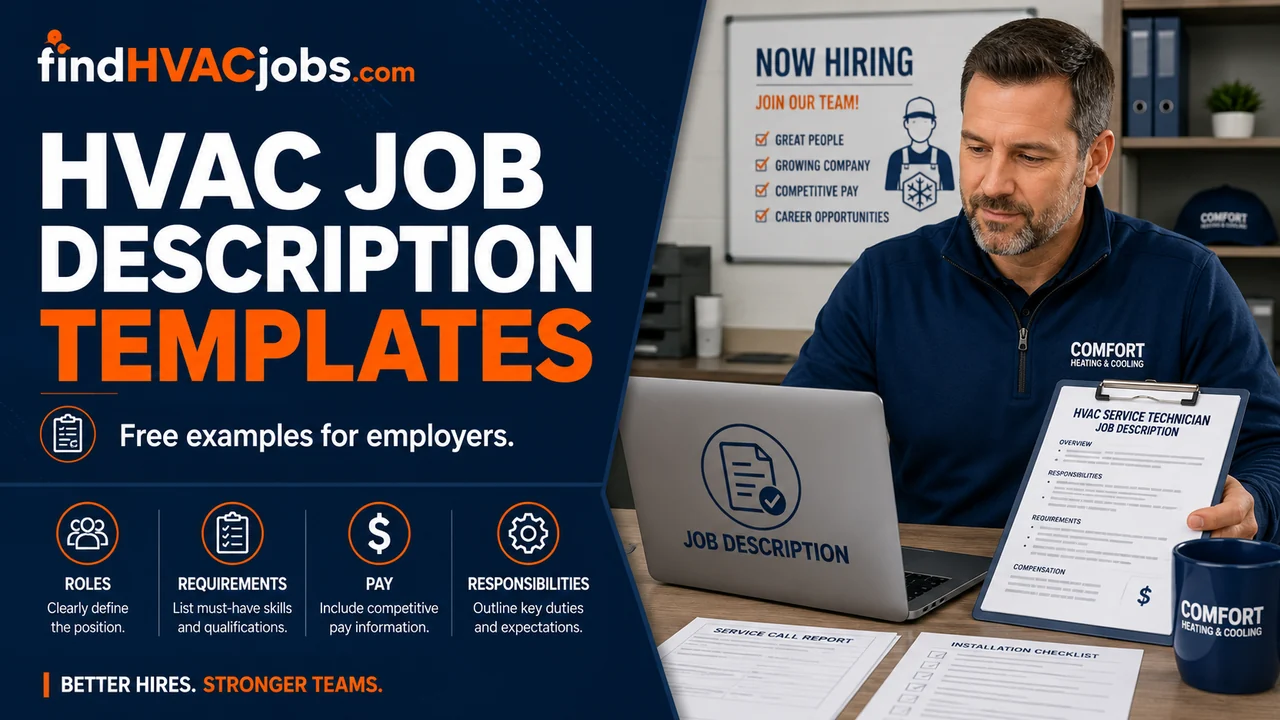
Hiring an HVAC technician starts with the job description. Not the interview. Not the phone screen. Not the job board.
If the posting is vague, underpaid, or stuffed with every skill your company has ever wanted, qualified techs will skip it. A strong HVAC technician job description should do four things fast: explain the role, show the pay range, list the real requirements, and give the technician a reason to apply.
That matters more in 2026 than it did five years ago. The Bureau of Labor Statistics (BLS) projects HVAC employment will grow 8% from 2024 to 2034, with about 40,100 openings each year. Median HVAC technician pay was $62,940 per year in the May 2025 BLS data, and the mean ran $64,780.
In other words: good techs have options.
Use the templates below as a starting point. Adjust the pay, location, licensing requirements, on-call schedule, and benefits before posting. Ready to hire? Post your HVAC job on findHVACJobs.com and put it in front of technicians who are already looking for HVAC work.
A good HVAC job description is specific. It tells a technician what they will work on, where they will work, what they will earn, and what you expect from them.
A weak one sounds like this: "Looking for a motivated HVAC tech. Must be dependable. Competitive pay. Great company culture."
That does not tell a serious technician enough to apply. A stronger HVAC technician job description includes every component below.
Job title: Use a searchable title like "HVAC Service Technician" or "Commercial HVAC/R Technician." Skip creative branding.
Pay range: Include hourly or annual pay, plus bonuses, commission, or overtime. "Competitive pay" is not a number.
Location: Spell out the city, state, service area, and whether the role is shop-based or field-based.
Schedule: Full-time, weekends, rotating on-call, emergency service, or seasonal overtime. Be honest about all of it.
Responsibilities: Specific systems, tools, diagnostics, installs, maintenance, and customer-facing work.
Requirements: EPA 608, driver's license, experience level, physical demands, and safety expectations. Cover state and local HVAC license requirements if they apply.
Benefits: Health insurance, 401(k), PTO, truck, tool allowance, training, uniforms, phone, or tablet. List the real ones.
Growth path: Apprentice to tech, tech to lead, lead to supervisor, service manager, or sales.
The goal is not to make the role sound perfect. The goal is to make it clear. Good technicians do not need another mystery job. They need to know whether the role fits their skills, schedule, and income goals.
The job title is one of the most important parts of the posting. It affects search visibility and candidate quality.
Avoid creative titles like Comfort Specialist, HVAC Ninja, Air Quality Warrior, or Service Rockstar. Those might feel fun internally, but technicians are not searching those terms. They are searching for clear job titles.
Use titles that match search intent and skill level.
General service role: HVAC Service Technician
Install-focused role: HVAC Installer
Experienced residential tech: Senior Residential HVAC Technician
Commercial service role: Commercial HVAC/R Technician
Refrigeration-focused role: Commercial Refrigeration Technician
Entry-level hire: HVAC Apprentice
Crew lead: Lead HVAC Installer
Controls role: HVAC Controls Technician
For local hiring, add the city or metro when possible: "HVAC Service Technician - Dallas, TX" or "HVAC Apprentice - Tampa, FL." This helps the posting match how technicians search and keeps the title direct.
Do not hide the pay.
A technician with five-plus years of experience, EPA 608 certification, a clean driving record, and strong diagnostic skills is not going to spend 20 minutes applying to a job that says "competitive pay." Put the range in the job description.
Examples:
Pay depends heavily on geography, experience, specialization, and license requirements. Before publishing, compare your range against your local market using your internal compensation data and the HVAC technician salary guide.
If you are below market, the job description will not fix the problem. You will need to raise the range, improve the benefits, offer training, or be realistic about the level of technician you can attract.
Use this template for a residential or light commercial service role.
HVAC Service Technician
We are hiring an experienced HVAC Service Technician to diagnose, repair, maintain, and install residential and light commercial heating and cooling systems.
This role is a fit for a technician who can troubleshoot independently, communicate clearly with customers, and take pride in doing the job right the first time. You will work on furnaces, air conditioners, heat pumps, ductless mini-splits, thermostats, indoor air quality equipment, and related HVAC components.
We provide steady work, a company vehicle, dispatch support, ongoing training, and a clear path for growth.
Apply with your resume or a brief summary of your HVAC experience. Include any certifications, licenses, and the types of systems you have worked on.
Hiring for a role like this? Post your HVAC Service Technician job on findHVACJobs.com.
Use this template when hiring for commercial buildings, rooftop units, refrigeration, chillers, controls, or facility maintenance.
Commercial HVAC/R Technician
We are hiring a Commercial HVAC/R Technician to service, troubleshoot, and maintain HVAC and refrigeration systems in commercial buildings.
This role is best for a technician with strong diagnostic skills and experience working on larger equipment, including rooftop units, split systems, boilers, chillers, pumps, motors, walk-in coolers, freezers, and building automation controls.
You will work with property managers, facility teams, and commercial customers to keep critical systems running safely and efficiently.
Apply with your resume or work history. Include the commercial systems you have worked on, refrigerant certifications, safety training, and any controls or refrigeration experience.
Hiring commercial HVAC/R techs? Post your job on findHVACJobs.com and reach technicians looking for HVAC-specific roles.
Use this template for entry-level hires, helpers, and apprentices. For more on building a strong apprentice pipeline, see our HVAC apprenticeship guide.
HVAC Apprentice
We are hiring an HVAC Apprentice to support our installation and service teams while learning the trade.
This is an entry-level role for someone who is mechanically inclined, dependable, safety-minded, and serious about building a career in HVAC. You will work under experienced technicians and installers while learning how to install, maintain, and repair heating, cooling, ventilation, and refrigeration systems.
No advanced HVAC experience is required, but you must be willing to work hard, learn quickly, and show up on time.
Apply with your resume or a short note explaining why you want to start a career in HVAC. Include any trade school, construction, mechanical, electrical, automotive, or maintenance experience.
Hiring apprentices? Post your HVAC Apprentice job on findHVACJobs.com and reach people actively looking to start in the trade.
One of the biggest mistakes employers make is turning a job description into a wish list. If every bullet says "required," you may scare off solid candidates who can do the job but lack one tool, brand, or software skill.
Separate true requirements from preferences.
Use these only for things the person truly needs on day one:
EPA Section 608 is especially important. EPA rules require technicians who maintain, service, repair, or dispose of equipment that could release regulated refrigerants to be certified, and technicians must pass an EPA-approved test. The credential does not expire.
Use these for skills that help but are not automatic dealbreakers:
This makes the posting more approachable without lowering your standards.
Three things matter almost as much as pay: when techs work, where they can grow, and whether your shop is keeping up with the trade.
Do not bury the on-call rotation. Do not hide weekend expectations. Do not make the job sound Monday through Friday if summer demand regularly means overtime.
Spell it out. Examples: "Monday–Friday, 7:30 AM–4:30 PM." "Rotating on-call every fourth week." "Overtime available during peak season." "Weekend emergency rotation required." "Local service area; home every night."
BLS notes that HVAC technicians may work evenings, weekends, overtime, or irregular schedules during peak heating and cooling seasons. Technicians already know this. Being upfront builds trust.
A better job description does not just sell the job. It sells the future. Many technicians leave companies because they do not see a path forward.
If you can offer growth, say so clearly. Examples: Apprentice → Installer → Lead Installer. Maintenance Tech → Service Tech → Senior Service Tech. Service Tech → Lead Tech → Service Manager. Commercial Tech → Controls Specialist. Senior Tech → Comfort Advisor or Sales.
You can also mention training support: paid EPA 608 preparation, NATE certification support, manufacturer training, heat pump training, A2L refrigerant training, safety training, tool allowance, and ride-alongs with senior technicians.
The best HVAC job descriptions show that your company is keeping up with the trade. That does not mean turning the posting into a technical manual. But it does mean you should mention the systems and tools that matter in 2026.
Include relevant experience with heat pumps, ductless mini-splits, smart thermostats, indoor air quality systems, building automation systems, commercial refrigeration, VRF systems, A2L refrigerants, R-454B, and field service software.
The refrigerant transition is a good example. Under the AIM Act, EPA is phasing down regulated HFCs to 15% of historic baseline levels by 2036. For employers, that means technicians with current refrigerant training and comfort around newer equipment are becoming more valuable. For candidates, it signals that your company is not stuck in the past.
A bad job description can make a good company look disorganized. Avoid these mistakes before you publish.
No pay range. "Competitive pay" is not enough. Real numbers attract real applicants.
Too many requirements. Do not require ten years of experience for a mid-level role. Move soft preferences to "nice to have."
Vague duties. "Repair HVAC systems" is too broad. List the equipment, the systems, and the customer environment.
No location clarity. List the city, service area, and travel expectations.
No schedule clarity. Be upfront about on-call, weekends, and seasonal overtime.
No benefits detail. List the real benefits, not just "great benefits."
No growth path. Show how a technician can move up.
No application instructions. Tell candidates exactly what to send and what happens next.
The job description should answer the candidate's main question: Is this job worth my time? If the answer is not clear, rewrite it.
Before you post, make sure your HVAC technician job description includes:
Need help getting the posting live? Use one of the templates above and post your role on findHVACJobs.com. For a deeper look at recruiting strategy, see our guides on how to hire HVAC technicians, the true cost of hiring an HVAC tech, and where to find qualified HVAC technicians.
An HVAC technician job description should include the job title, location, pay range, schedule, responsibilities, required certifications, physical requirements, benefits, and how to apply. For roles involving refrigerant work, include EPA Section 608 certification requirements. The more specific you are, the easier it is for qualified technicians to decide whether the job fits.
Yes. Include a clear hourly or annual pay range. The national median HVAC technician pay was $62,940 per year in May 2025 according to BLS, and experienced technicians in high-demand markets can earn much more. If your pay range is missing, many qualified candidates will skip the posting. See current market rates in our HVAC salary guide.
Use a clear, searchable title like "HVAC Service Technician," "Commercial HVAC/R Technician," "HVAC Installer," or "HVAC Apprentice." Avoid internal nicknames or creative titles. The title should match what technicians are actually searching for on job boards and Google.
Yes, if they maintain, service, repair, or dispose of equipment that could release regulated refrigerants. EPA requires technicians to pass an EPA-approved test for Section 608 certification, and the credential does not expire. For apprentice roles, you can list EPA 608 as preferred if the person will earn it during training.
Most HVAC job descriptions should be long enough to explain the role clearly without becoming a wall of text. A practical range is 700–1,500 words for a full posting. Keep the structure scannable with short paragraphs, bullets, and clear sections for pay, responsibilities, requirements, and benefits.
Mention health insurance, PTO, 401(k), company vehicle, gas card, uniforms, tool allowance, paid training, certification support, overtime, on-call pay, and advancement opportunities. Do not just say "great benefits." List the specific benefits a technician will actually receive.
You can post on general job boards, your company website, trade school career centers, local groups, and HVAC-specific job boards. For specialized hiring, an HVAC-focused board like findHVACJobs.com helps put the role in front of candidates already searching for HVAC jobs in Texas, Florida, California, Arizona, Massachusetts, and every other state.
