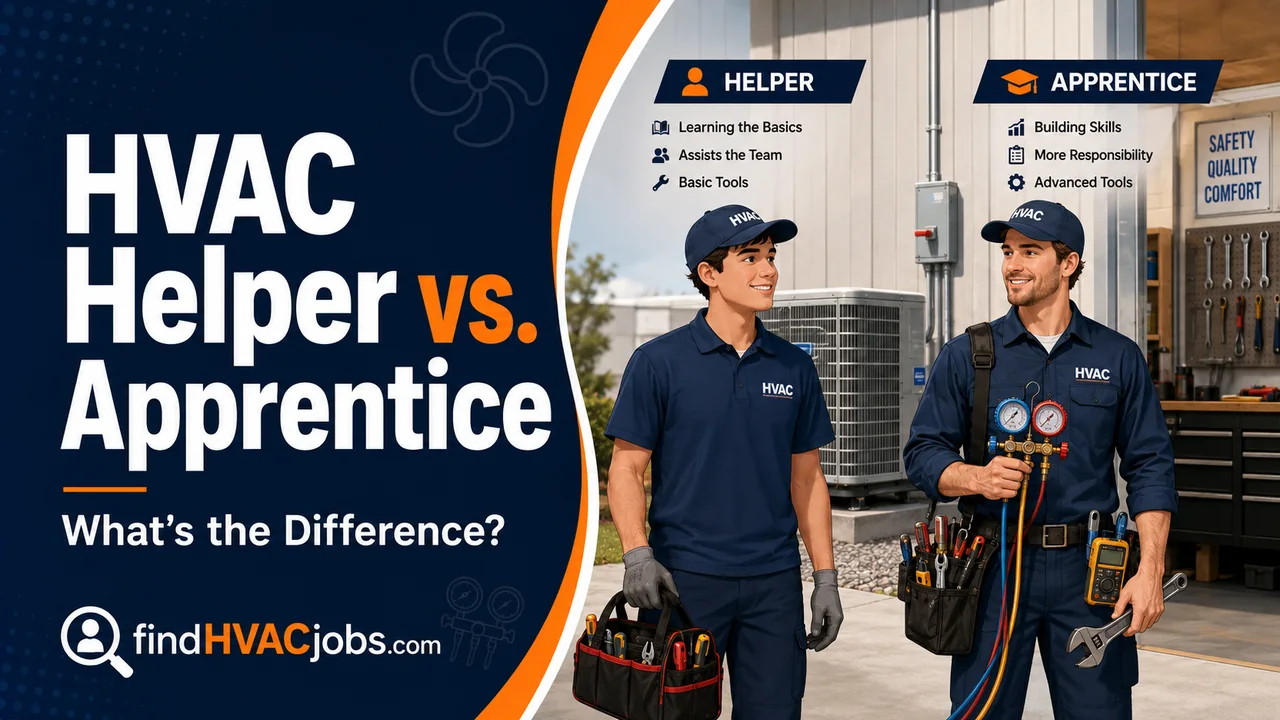
A helper is a job. An apprenticeship is a program with an exit. That is the whole difference, and it matters more than the pay gap, which is smaller than most people think. On our board right now, HVAC helper jobs carry a posted median of $41,600 per year and apprentice jobs post at $44,720. That is $3,120 apart, or about $1.50 per hour.
But here is the number nobody tells you. In our July 2026 analysis of 5,281 active listings, 27.5% of jobs titled "helper" demanded prior experience. For apprentice listings, it was 12.8%. The rung that gets marketed as the no-experience way in is the one most likely to ask for experience anyway. Keep that in mind as you read the fine print on any posting.
A helper is the extra set of hands on an install or service crew. You carry and stage equipment, run line sets, pull wire, hang duct, flush drain lines, and clean the site when the licensed guys are done. In August, that means handing flex duct to a lead installer in an attic that reads 130°F while your shirt quits absorbing anything by 10 a.m. Nobody romanticizes helper work because there is nothing romantic about it.
Most shops ask for three things: a driver's license, the ability to lift 50 pounds, and showing up on time every single day. That last one washes out more helpers than the heat does.
What a helper job does not include is structure. No logged hours, no classroom time, no wage schedule, no credential at the end. You learn what the crew happens to be doing that week. Good crews teach. Bad crews just hand you the shop vac for a year.
A registered apprenticeship is a formal program filed with the U.S. Department of Labor or your state apprenticeship agency, and the structure is standardized: roughly 2,000 hours of paid on-the-job training per year plus a minimum of 144 hours of classroom instruction per year, usually one evening a week. Most HVAC programs run three to five years. You are an employee from day one, earning on a wage schedule that steps up as you log hours, and federal rules require that schedule to increase as you progress.
The classroom half covers what the truck never gets around to: refrigeration theory, electrical, load calculations, code. Somewhere in the first year or two you sit for EPA 608, because you cannot legally touch refrigerant without it.
And at the end you hold something. Completion of a registered program is the standard path to journeyman licensing in most states that license the trade. See our state licensing guide for how your state handles it, because they genuinely all handle it differently.
Posted medians from active listings on our board, July 2026:
Helper: $41,600 per year
Apprentice: $44,720 per year
Installer: $66,560 per year
Technician: $74,880 per year
Across helper and apprentice offers combined, the median posted wage is $22.00 per hour. For context, BLS puts the mean for installation and repair helpers at $40,750 per year (SOC 49-9098, May 2024) and the median for HVAC technicians at $62,940 per year (SOC 49-9021, May 2025). What employers are advertising today runs ahead of the government survey data, which lags the market by design. The full readout is in our weekly salary report.
Read that ladder again, though. The move from helper to apprentice is worth $3,120 per year. The move from apprentice to installer is worth $21,840. The entry-level pay question is a distraction. The real money question is which path gets you off the bottom two rungs faster, and that is the apprenticeship, every time, because the hours count toward something.
Back to that 27.5%.
More than a quarter of helper listings in our data require prior experience for a role whose entire reason to exist is that it requires none. Some of that is employers using "helper" as a cheap label for a second-year tech. Some of it is boilerplate laziness. Either way, if you are applying to helper jobs with a blank resume, expect that roughly one in four postings was never really open to you, and do not take the silence personally.
Apprentice listings run cleaner at 12.8%, partly because registered programs are built to take beginners and partly because a shop sponsoring an apprentice has already decided to train. Across everything titled entry-level on our board, 18.4% asked for experience anyway. We track this number every month because it is the honest measure of how open the front door of this trade actually is.
Browse the current helper and apprentice openings and read the requirements line before anything else. It tells you more about the shop than the pay line does.
If a registered apprenticeship will have you, take the apprenticeship. The $3,120 gap is noise against a wage schedule that steps up on a defined timeline and a credential that follows you between employers and across state lines. Four years from now, the helper who never converted is negotiating from hope. The apprentice is negotiating from hours.
Take the helper job instead when one of these is true: there is no program within reach, you want to test the trade before committing three to five years to it, or you need a paycheck now and the local program's next intake is months out. Those are all legitimate. So is working one around trade school classes; our guide to working in HVAC while in school covers how students make the schedule fit. A helper job is a fine place to start. It is a bad place to still be at year three.
Set yourself a deadline. Twelve months, maybe eighteen. If the shop has not moved you toward an apprenticeship by then, the shop is telling you what you are to them.
Ask your shop first. Plenty of contractors sponsor registered apprentices and simply never mention it to the helpers, because a helper who never advances is cheap. Asking costs nothing and signals exactly what a sponsor wants to see.
If your shop will not sponsor, search apprenticeship.gov by zip code for registered sponsors, union locals, and training providers near you. Union programs through UA locals tend to run longer and pay better on the back end. Some areas also run pre-apprenticeship programs that feed directly into registered ones, worth a look if your resume is truly blank. We covered how Florida's programs work as an example of what to expect, and our how to become an HVAC technician guide maps the full route.
Two moves that help either way: knock out EPA 608 on your own, since it is cheap and shows intent, and go where the work is. Helper and apprentice demand runs strongest in growth metros like Phoenix, Houston, Las Vegas, Tampa, and Atlanta, and states like Texas, Florida, Arizona, and California carry the deepest listing volume. Wage data for every state is in our HVAC salary guide.
Do HVAC helpers need experience? Usually no. Most helper roles ask for a driver's license, physical capability, and reliability. But 27.5% of helper listings in our July 2026 data required prior experience anyway, so read each posting's requirements line before applying.
How much does an HVAC helper make? The posted median on our board is $41,600 per year as of July 2026. BLS reports a mean of $40,750 per year for installation and repair helpers (SOC 49-9098, May 2024). Advertised wages currently run slightly ahead of survey data.
How long is an HVAC apprenticeship? Three to five years for most registered programs. The standard structure is about 2,000 hours of paid on-the-job training per year plus a minimum of 144 classroom hours per year, with wages stepping up as you log hours.
Is it better to start as a helper or an apprentice? Apprentice, if a program will take you. The posted pay difference is only $3,120 per year, but apprenticeship hours count toward journeyman licensing and the wage schedule is guaranteed to rise. Helper is the right call when no program is available or you want to test the trade first.
Can a helper become an apprentice? Yes, and it is one of the most common routes in. Ask your current shop about sponsorship first, then search apprenticeship.gov for registered sponsors near you. Time in a helper role often shortens the informal vetting a sponsor would otherwise do.
Ready to commit to the structured path? Pay by year, program requirements, and how to apply are all covered in our guide to HVAC apprenticeships.
