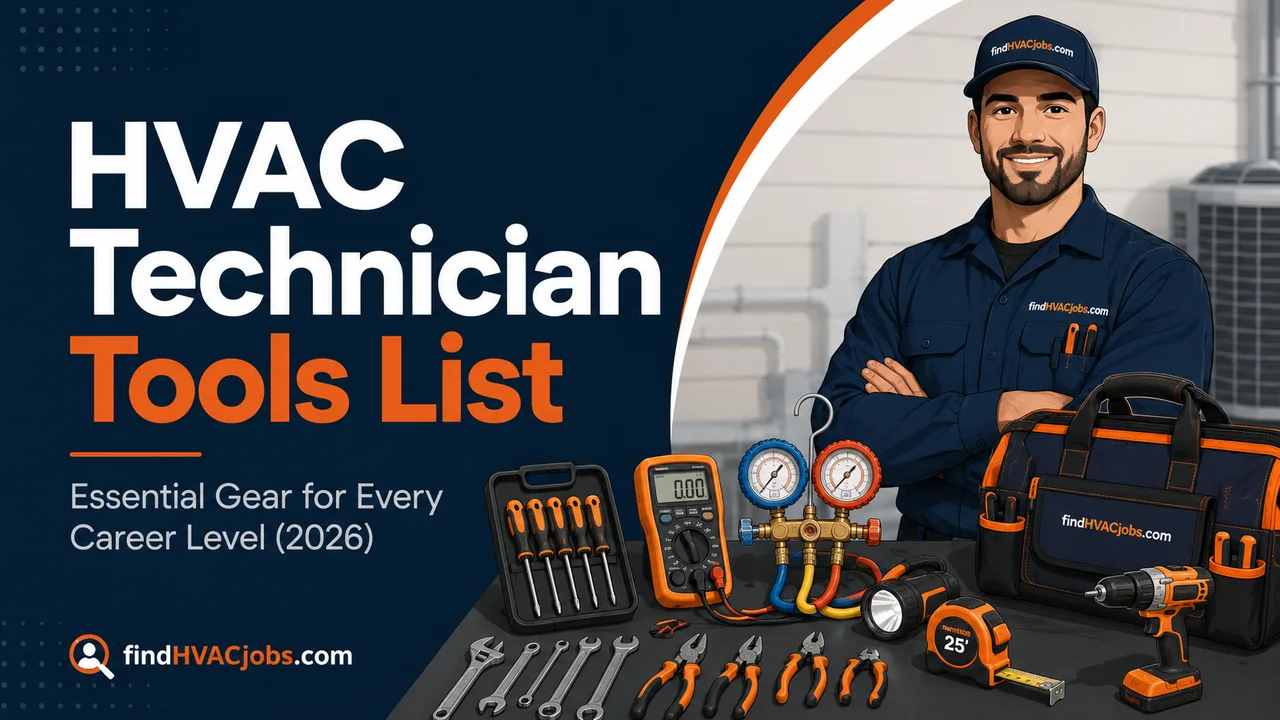
Your tools are the one thing on the job that's actually yours. Show up to an HVAC apprenticeship with a solid starter kit and you look serious. Show up empty-handed and you're borrowing a screwdriver from a journeyman who's already annoyed you're slowing down the call.
This HVAC technician tools list breaks down what to buy at each stage, roughly what it costs, and which brands hold up in the field. An apprentice doesn't need a $1,200 combustion analyzer. A senior commercial tech shouldn't be diagnosing a rooftop unit with a $12 meter. Match the gear to where you are in your career.
One rule before the lists: buy quality on the stuff you touch every day, and go cheap on the stuff that gets lost anyway. A good pair of pliers lasts a decade. Your first small tubing cutter is going to walk off a jobsite within a year no matter what you paid for it.
Most techs build their kit over five to eight years, not in one shopping trip. Here's the money and the logic behind each tier.
Apprentice starter kit: $200 to $500. Hand tools, one basic meter, and safety gear. Enough to pull your weight on an install or service crew without draining your first paycheck.
Journeyman professional set: $500 to $1,500. Digital gauges, a vacuum pump, a micron gauge, and a real meter, so you stop borrowing and start diagnosing on your own.
Senior and specialist tools: $1,500 to $3,000 and up. Recovery machines, combustion analyzers, electronic leak detection, and airflow instruments. Commercial and refrigeration work lives in this tier.
Now the details.
You're the extra set of hands right now. Your job is to be useful, not to own every gadget. This covers you on almost any residential install or service call.
Start here. These are the tools you'll reach for on your first day and still be using twenty years in.
You need one real electrical tool. A basic multimeter that reads capacitance lets you test a run capacitor, and the capacitor is the part that fails first on most no-cool calls. Learning to check one on day one makes you useful fast. Klein MM600 or an entry Fieldpiece meter runs $50 to $100. You'll upgrade later, so don't overspend here.
Attic and crawlspace work is a huge slice of residential service. In a Phoenix or Houston attic in August you're looking at 130°F on your knees, so knee pads and a headlamp aren't extras. Safety glasses, cut-resistant gloves, knee pads, and a good headlamp run about $60 to $100 together.
New to the trade? Our HVAC apprenticeship guide covers how to land your first spot, and you can browse open apprentice and helper jobs to see who's hiring near you.
Once you're running calls solo, you need to diagnose and charge systems without waiting on anyone. This is the tier that pays for itself.
Handling refrigerant legally means passing your EPA 608 certification first. Once you've got it, refrigeration and HVAC tech roles open up, and they tend to pay better (the HVAC salary guide has the numbers by experience level).
This tier is about commercial work, refrigeration, and the diagnostics that let you charge a premium. Not every tech needs all of it. Buy what your work actually calls for.
Specialist gear like this is part of what separates a $28-an-hour installer from a senior commercial tech near the top of the pay scale. Weighing the trade against other paths? We put HVAC against the electrician career side by side, and demand runs hot in states like Texas and Arizona where the AC never really shuts off.
This trips up a lot of new techs, and the line moves from shop to shop. Ask on day one so you're not double-buying.
Usually the shop's gear. The expensive, shared, or consumable stuff: recovery machines, vacuum pumps, nitrogen bottles and regulators, ladders, the refrigerant itself, and truck stock like fittings, wire, and contactors. If a shop makes you buy your own recovery machine, ask why in the interview. It's a fair question and the answer tells you a lot.
Usually yours. Hand tools, your bag or pouch, personal safety gear, and often your own meters and gauges. Plenty of techs prefer owning their meters anyway. You learn one tool cold that way instead of relearning whatever's rattling around the shared bin.
It genuinely varies by role. A new-construction install crew carries less personal gear than a residential service tech who's solo in a truck all day. If there's a tool allowance, get the amount in writing.
If you're mapping the path from helper to lead tech, our guide to becoming an HVAC technician lays out the steps, and entry-level helper jobs are a solid on-ramp.
Bag style is close to a religious argument in this trade. Here's the honest breakdown of the three main camps.
A few habits that save you real time and money:
Keep your meters in a hard case, not loose in the bag. A dropped clamp meter is a $200 lesson.
Set the truck up in bins by category: electrical, refrigerant and copper, sheet metal, PVC and drain, and PPE. You want to grab a bin, not dig through a pile.
Don't haul the whole kit to every call. Read the ticket, grab what the job needs, and keep a small service pouch for the capacitor-and-contactor calls that make up most of your day.
Engrave or paint-mark every tool. Jobsite theft is real, and a marked tool is the one that actually comes back to you. A magnetic parts tray stuck to the condenser also saves you crawling through gravel looking for panel screws.
Good tools won't make you a good tech. Reps will. But the right kit lets you do the work without fighting your own gear. Build it out as you grow, spend where it counts, and get after it. See who's hiring HVAC techs right now.
How much does a full set of HVAC technician tools cost?
A working apprentice kit runs $200 to $500. A journeyman set with digital gauges, a vacuum pump, and a micron gauge lands between $500 and $1,500. Senior and specialist tools, including recovery and combustion equipment, push past $3,000. Most techs spread that cost over several years rather than buying it all at once.
What tools does an HVAC apprentice need to start?
Nut drivers, insulated screwdrivers, pliers, wire strippers, aviation snips, a small tubing cutter, a basic multimeter, and safety gear. That covers you on most install and service calls for around $200 to $500. The full apprentice list above breaks down brands and prices, and our apprenticeship guide covers how to get started.
Do HVAC companies provide tools?
Most shops provide the expensive shared gear: recovery machines, vacuum pumps, nitrogen, and truck stock. You're usually expected to bring your own hand tools and safety gear, and often your own meters. Ask exactly what's covered before your first day so you don't buy something the company already stocks.
What is the most important tool for an HVAC technician?
A quality multimeter. Most service calls come down to an electrical fault, and a meter that reads capacitance and microamps lets you test capacitors and flame sensors, two of the most common failures in the field. The Fluke 116 is a popular pick for a reason.
What brands of HVAC tools are worth the money?
Fluke and Fieldpiece for meters, Testo and Fieldpiece for digital gauges, Klein and Knipex for hand tools, Malco for sheet metal, and Appion for recovery. The rule holds across all of them: buy quality on the tools you use daily, and save on the ones that get lost or worn out.
Tools get you on the truck. A license and the right training keep you climbing. Check your state's HVAC license requirements, and if you're still choosing a program, compare HVAC trade schools before you enroll.
